Event Coverage
Uday Shankar, citing TRAI tariff order, suggests govt should unshackle instruments of monetisation

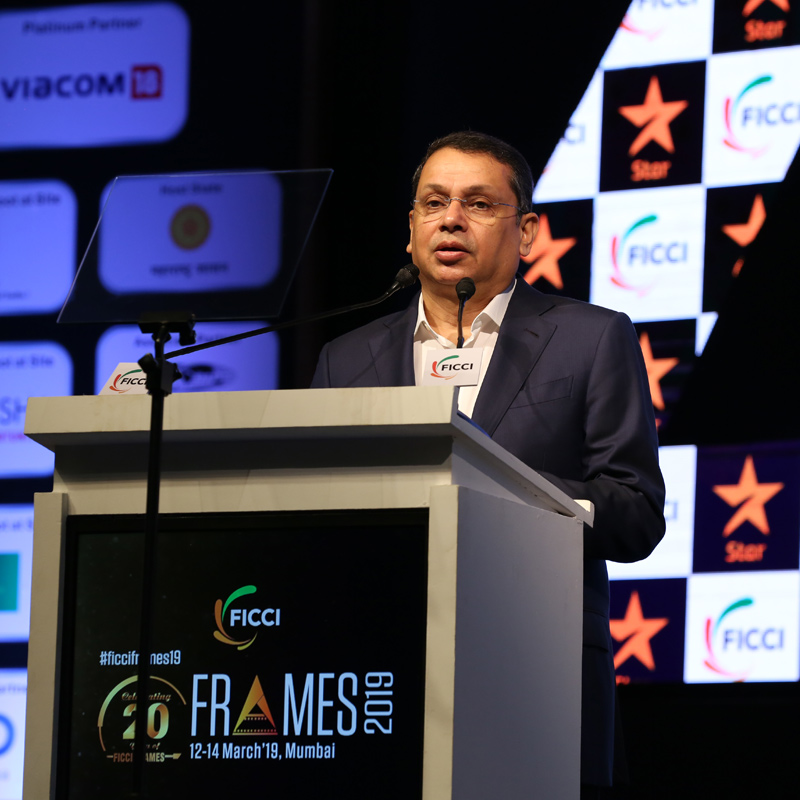
MUMBAI: Uday Shankar believes one of the most ‘powerful’ means of fuelling the next decade of growth for India’s media and entertainment industry is for the government to ‘unshackle the instruments of monetisation’. Driving home his point, the veteran executive cited the Telecom Regulatory Authority of India’s (TRAI) as an example.
“Distribution regulation of television content, where what you can charge from the consumer regardless of how much you invest in the content, is determined by the regulator and not the market,” Shankar said on the opening day of FICCI FRAMES 2019, where he moderated a session titled ‘Global Goes Indian’ featuring MIB secretary Amit Khare and Prime Minister Narendra Modi’s Economic Advisory Council chairman Bibek Debroy as panellists.
Shankar wondered whether there was a need for India to revise its ecosystem in order to compete in the global content market place.
“When a Hollywood film is made, or when Netflix or Amazon produce a series, they are able to monetise it across the world and hence their ability to invest in that content is a great deal more. In India, especially for TV, because of restrictions on how and how much can you monetise, there is a cap on investment. There are regulations on the affiliate monetisation front. So, your ability to monetise is limited,” he argued.
Shankar channelled his inner newsman as he highlighted some of the most pressing issues facing India’s media and entertainment industry. The recently appointed Disney APAC boss referred to a series of stumbling blocks across film, TV and digital content creation that could delay the sector from realising its true and full potential.
The 56-year-old focused on three key areas that needed addressing for the Indian M&E to grow at a faster pace. The FICCI vice president drew the attention of the panellists and the audience to issues plaguing content creation, monetisation and the need for government policies and regulations to be consistent.
Shankar rued the fact that India wasn’t adding more theatres in tune with the times. He pointed out that the increase in number of screens was a result of single screen theatres being converted to multiplexes.
“New theatres are not coming and while more films are being released in Hindi and regional languages, it becomes a challenge for them to get exhibited because there are not enough screens. While the big budget films are still accepted by theatres, the smaller and regional films are struggling. This problem looks like it’s going to get more and more complex,” he said.
Shankar then shifted his focus to the lack of adequate infrastructure, adding how this was preventing creators from scaling up their focus on local and city-specific content across the country. To further build on his perspective, Shankar offered the example of Mumbai’s film city.
“We had one film city which used to cater to the needs of the film industry and a few TV channels. Now, we still have the same film city which has to cater to the needs of the much diversified industry,” he stated.
Shankar asked whether policy development by the government, given that M&E is a major employer, would be a potential problem solver. However, he made it clear that the industry isn’t seeking any special favours from the government.
“The entire content for whole Hindi heartland from Bihar all the way to MP, Rajasthan, Gujarat and Haryana is created out of Mumbai because it is the only city where basic infrastructure still exists. A decade ago, there were initiatives to launch Bhojpuri channels designed to cater only to the population of Bihar and some parts of UP. But all those channels turned out to be unviable because there was no facility to create content locally and all of them had to come and rent expensive facilities in Mumbai and create content here. There are no facilities available outside Mumbai. Is this a subject needs that needs to be addressed via policy intervention?” he asked the panel.
Shankar then drew a parallel to how a complex process at every level had been a hindrance to investment in theatre infrastructure.
“For instance, the reason malls are coming up everywhere and no theatre is being made is simply because the entire policy around building a new theatre, in terms of all requirements, is too complicated,” he said.
Shankar made another critical point as he highlighted the need for government policies to be consistent.
“There has to be certainty of regulation. You should know what is expected of you and what you need to deliver. There should be no surprises, because surprises create a shock in the system and everyone takes time to recover from that,” he stated.
Earlier in the day, during his opening remarks, Shankar described India as one of the major media markets in the world. According to him, Indian M&E is at an inflexion point.
“We are already seeing the innovations that are taking place in this country in the domain of sports or in digital, where Indian creativity is being talked about globally and attracting the interest of one and all. However, we need to make sure that our policies are aligned to accelerate creativity and growth,” he said.