iWorld
Likee backs PM’s call for social distancing
MUMBAI: Short video platform Likee has taken yet another step towards fulfilling its corporate social responsibility by urging all to comply with Prime Minister Narendra Modi-led Indian government’s call for staying at homes during the lockdown triggered by COVID-19 aka Coronavirus pandemic. The message was also conveyed by the global platform on some of the most reputed TV news channels during PM Modi’s address to the nation formally announcing the lockdown extension.
The platform, home to tens of millions of users from India as well as other countries, has constantly been striving to ensure that its users adhere to social distancing and bolster the worldwide war against the dreaded novel virus. One #LockdownkiHalat hashtag, which is among the top trends on the app, asked all users to share how they are spending time at their homes during the (previously 21 days’) lockdown to save themselves and the society on the whole. The hashtag clocked more than 211 million views. The app also has a dedicated COVID-19 dashboard, furnishing data from different states in India as well as other countries, sourced from the Union Ministry of Health and Family Welfare along with the World Health Organization (WHO).
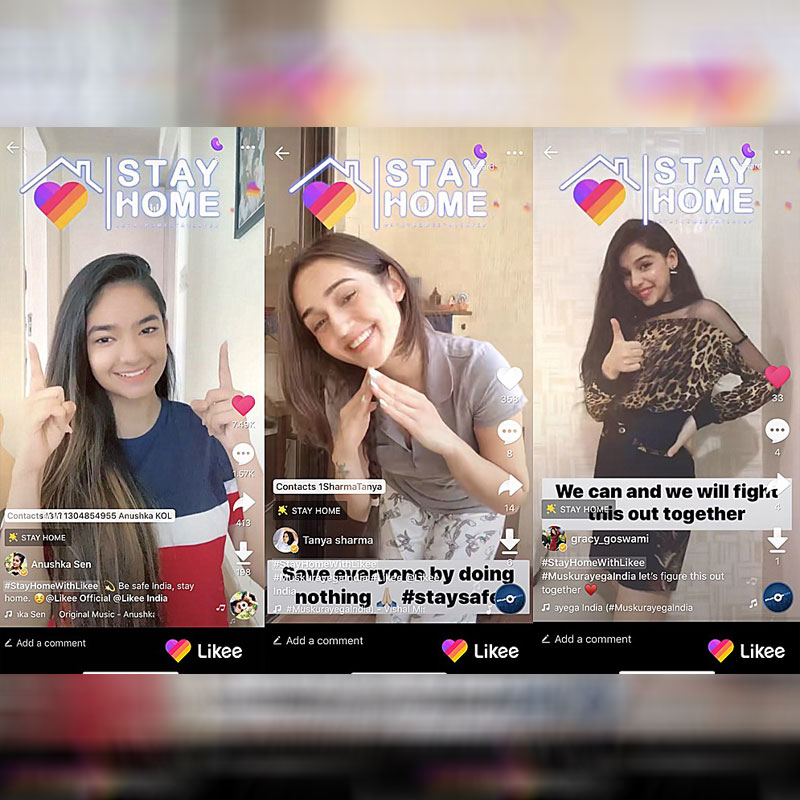
Taking the stride further, the global app by Singapore-based BIGO Technology Pte Ltd has now asked all to #StayHomeWithLikee. As part of the initiative, Likers have been asked to indulge in creative video making and spend their lockdown time with a positive spirit. Likee influencers including Anushka Sen, who is a popular television actress, too will create and post videos around the theme.
Recently, Likee partnered with Jjust Music and Cape of Good Films to promote #MuskurayegaIndia, which is an attempt by the Bollywood fraternity to spread positivity in these trying times and reassuring that India will smile again. PM Modi himself had taken to microblogging site Twitter to post the music video of the song that starred superstar Akshay Kumar, Ayushmann Khurrana, Kriti Sanon and Ananya Pandey, among others. Actor-producer Jackky Bhagnani and Bollywood singer Palak Muchhal went live on Likee to spread the message among users that everyone needed to stay home and stay safe.
Likee spokesperson Mike Ong said, “Likee is always committed to undertake social responsibility and make a contribution to the local society. With a variety of initiatives to support the efforts of the Indian government, Likee has emerged as a responsible global platform in the wake of the COVID-19 outbreak.”

iWorld
WhatsApp emerges as key commerce channel in India: Meta report
Whitepaper shows 77 per cent of purchases influenced by social media and shoppers spend 2.5 times more across channels
MUMBAI: If shopping once meant a stroll down the high street, today it begins with a scroll on a smartphone. India’s retail journey is being rewritten in real time, as consumers glide between Instagram Reels, WhatsApp chats and physical stores with barely a pause for thought. A new whitepaper by Meta in collaboration with the Retailers Association of India argues that this shift is not cosmetic but structural, powered by artificial intelligence, short form video, creators and conversational commerce.
The numbers underline the scale of the change.
Social media now influences 77 per cent of retail purchase decisions in India, with Meta’s platforms accounting for 96 per cent of social driven discovery. Discovery itself is increasingly passive and visual rather than deliberate and search led. As much as 97 per cent of consumers watch short form video daily, and 60 per cent of time spent on Facebook and Instagram is devoted to video content.
In other words, the shop window has moved to the feed.
The report highlights the growing dominance of the omnichannel shopper, a consumer who researches and buys fluidly across online and offline environments. More than 50 per cent of retail consumers research products online before purchasing in store. Equally, over 50 per cent browse in store before completing their purchase online.
This blended behaviour is lucrative. Shoppers who buy across channels spend 2.5 times more than single channel shoppers. When customers engage across multiple touchpoints, spending rises by as much as 73 per cent. For retailers, unified commerce is no longer a strategy slide. It is a revenue imperative.
Meta India director of E commerce and retail Meghna Apparao, urged brands to focus on three pillars: Reels and creators for authentic storytelling, omnichannel performance marketing to connect platforms, and WhatsApp as a personalised commerce channel. Hitesh Bhatt of RAI noted that the challenge is no longer adopting digital tools but integrating them to deliver measurable outcomes.
Artificial intelligence sits at the heart of this integration. Indian retailers using Meta’s omnichannel optimisation have recorded more than fourfold improvements in omnichannel return on ad spend. Businesses that integrated in store sales data through Meta’s Conversions API have reported Roas uplift ranging from 2 times to 5 times or more, alongside incremental sales growth of up to 9 times depending on category and market.
Integrated data strategies have also delivered revenue growth of up to 15 per cent, suggesting that when digital signals are tied to offline outcomes, marketing efficiency sharpens considerably.
Retailers are already putting this into practice. Reliance Digital has leaned into a Reels first strategy, working with regional creators to drive engagement and measurable business impact. Croma says Meta’s AI powered tools have enabled it to integrate offline data and activate performance marketing across touchpoints, strengthening both footfall and revenue across online and physical stores.
Trust is increasingly creator led. The report finds that 71 per cent of consumers make a purchase within a couple of days of seeing creator content on Meta’s technologies. Campaigns that leverage reels and creators have delivered 71 per cent higher brand intent lift and 19 per cent lower acquisition costs.
Micro and nano creators, in particular, are accelerating purchase decisions by embedding products into relatable, local narratives. Influence is no longer confined to celebrity endorsements. It is distributed, conversational and continuous.
If Instagram and Facebook drive discovery, WhatsApp is emerging as the conversion engine. According to the report, 72 per cent of product discovery now happens on WhatsApp. Retailers using business messaging and click to WhatsApp campaigns are seeing a 61 per cent average improvement in return on ad spend, a 62 per cent increase in leads and 22 per cent higher order values.
The implication is clear. Commerce is shifting from clicks to conversations. Discovery, purchase and post purchase support increasingly unfold within a single chat thread.
The whitepaper argues that omnichannel maturity will define competitiveness in Indian retail. Consumers no longer toggle between online and offline modes. They operate across both simultaneously, often within the same buying journey.
For brands, the task is no longer about being present on digital platforms. It is about stitching together discovery, data, conversation and store experience into a unified loop that can be measured in footfall, revenue and repeat purchase.
As India’s shoppers continue to scroll before they stroll, the retailers who align AI, creators and messaging into one seamless experience may find that the path to growth is less about adding new channels and more about connecting the ones they already have.