MAM
Staqu announces its collaboration with Raymond

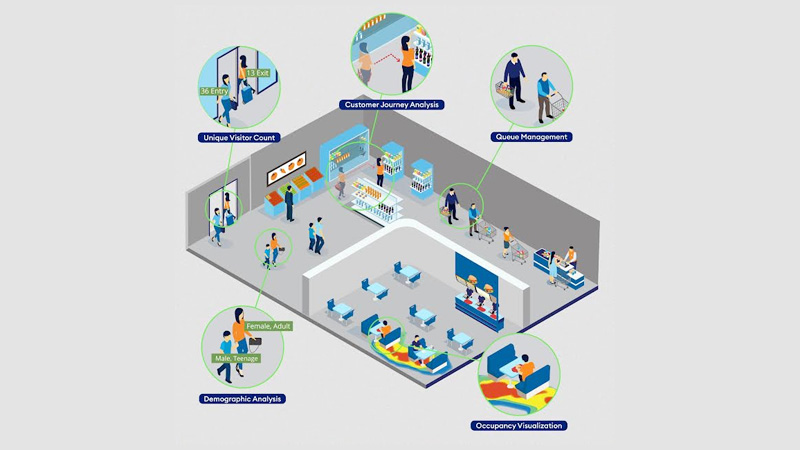
Mumbai: Staqu, an AI implementation enabler, announced its collaboration with Raymond, a fashion and lifestyle industry. Together, they aim to revolutionise Raymond’s offline retail stores by integrating JARVIS into their existing CCTV systems, making them more intelligent and insightful. By leveraging Staqu’s cutting-edge JARVIS solution, Raymond will equip its extensive network of 1400 stores across India with advanced video analytics capabilities.
Raymond has taken a significant leap forward by integrating JARVIS to enhance customer engagement and provide a seamless shopping experience. This cutting-edge technology analyzes customer purchasing patterns, conducts demographic analyses, counts unique visitors, monitors section-wise occupancy, identifies abandoned footfall, and offers counter assistance.
Commenting on the partnership, Staqu co-founder and CEO Atul Rai said, “We believe in innovating and utilizing our technological prowess in AI and Deep Tech to improve the shopping journey of customers. We are proud to partner with Raymond, a brand synonymous with quality and innovation. Our AI platform, JARVIS, is designed to enhance the customer experience, and we are confident it will provide immense value to Raymond’s drive overall business growth with this collaboration, we hope to set a new benchmark in the retail industry.”

He further added, “The e-commerce market has long provided businesses with customer insights that offline stores lacked. However, with JARVIS, offline stores can now collect and analyze customer data to make informed decisions. JARVIS provides real-time customer insights, allowing businesses to optimize stores and store-oriented marketing campaigns.”
Key benefits of Jarvis AI video analytics at Raymond stores
. Analysis of total footfall.
. Analyzes customer demographics.
. Linking footfall with sales for analysis of conversion rates.
. Analyzing peak store times to offer insights into the effectiveness of promotions and layouts.
. Provide aggregate store-level data for measuring performance.
. Analyze store occupancy by section to understand performance in different areas.
. Ensures safety compliance
. Identifies customers leaving without purchasing
. Sends alerts for store opening and closing times.
. Enhances customer service quality with real-time insights and alerts
Raymond CTO Ravi Hudda expressed his enthusiasm, “Our association with Staqu to deploy JARVIS has elevated our retail experience manifold and set a new benchmark for leveraging AI in the fashion industry. With this platform, we are not only embracing the power of AI but also ushering in a new era of customer experiences across our vast network of stores.”
Jarvis boasts advanced video analytics, enabling Raymond to analyze demographics, customer journeys, and conversion rates in real-time, turning data into actionable insights.
The platform’s plug-and-play nature makes it convenient to integrate into existing CCTV camera installations. Raymond’s stores across the country have onboarded JARVIS using an in-house technique that utilizes Private IP rather than RTSP from Public IP. The Jarvis dashboard provides insights at both the individual store level and aggregate levels.
Jarvis ensures safety and data analytics through seamless technology. Its plug-and-play capability only requires a stable internet connection. JARVIS analyzes video data coming from CCTV, offering comprehensive insights. Staqu sets itself apart by combining video management software and video analytics into a single platform, enhancing efficiency beyond other solutions. Unlike other market players that only facilitate post-event analysis or day-by-day reporting, Staqu ensures a continuous flow of communication and enhanced safety.







AD Agencies
Omnicom Advertising names Ellie Brocklehurst chief growth and marketing officer for Asia
The former TBWA Asia marketing chief returns from maternity leave with an ambitious mandate to make Omnicom the most sought-after network in the region.

NEW YORK: Ellie Brocklehurst is back, and she is not easing herself in gently. Omnicom Advertising has appointed Brocklehurst as chief growth and marketing officer for Asia, a role that puts her in charge of growth and marketing initiatives across the network’s three flagship agencies: BBDO, McCann and TBWA. Her brief is to sharpen existing capabilities while identifying new avenues for expansion across the region.
Brocklehurst brings a career that has moved steadily upward through some of the industry’s most recognisable names. She began at Source Music before moving through Exposure Public Relations and Marketing, Taurus Marketing and LEWIS Global Communications. She then joined BBDO Worldwide as communications manager for the Asia group, rising to regional communications director for Asia. At Wunderman Thompson, she served as head of marketing and PR for APAC before being elevated to APAC growth marketing lead, where she worked closely with local management teams on client expansion strategies, new business acquisition and brand building. Most recently, she served as chief marketing officer at TBWA\Asia.
Brocklehurst, who is returning from maternity leave, was characteristically direct about what she intends to do with the opportunity. “Transitioning back from my final maternity leave is a significant personal milestone,” she said. “While it’s the end of one era at home, it marks the beginning of an ambitious new one professionally.” She left little doubt about the scale of her ambition. “I’m stepping into this role with a clear mission: to make Omnicom Advertising the most awarded, revered, and sought-after agency network in Asia.”
In a region where agency networks are jostling hard for creative dominance and client loyalty, that is a target worth watching. Brocklehurst has spent two decades learning exactly how this game is played. Now she gets to set the rules.