MAM
When Burger King told patrons to order McDonald’s
NEW DELHI: Fast food chain Burger King caused a stir on social media when it appealed to patrons to order from arch-rival McDonald’s and other competitors to help them survive the Covid2019 pandemic.
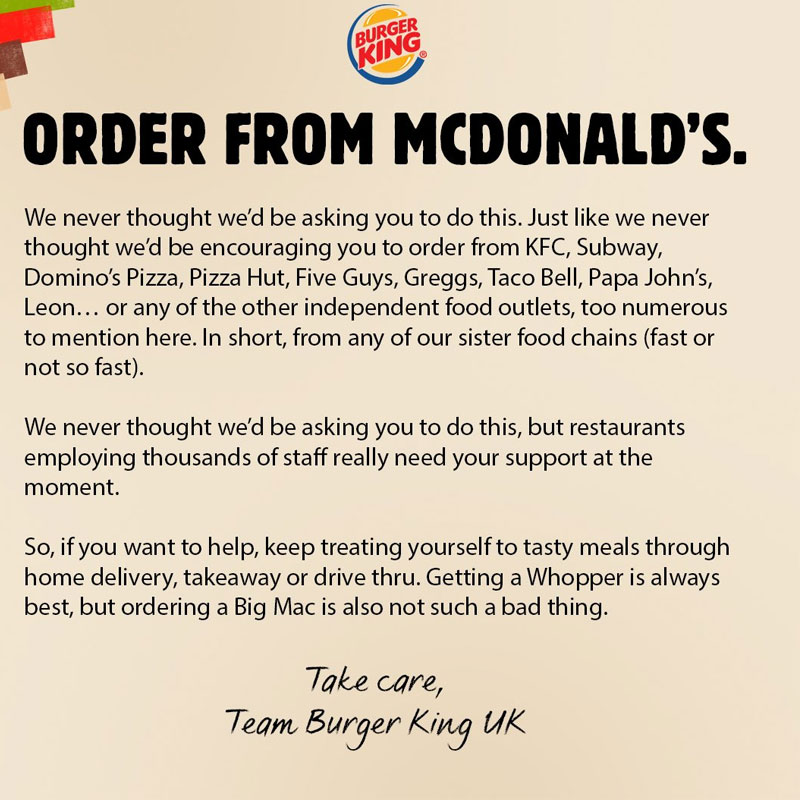
Taking to Twitter, Burger King's UK team encouraged customers to support local restaurants during the four-week-long lockdown recently announced in the country.
“We never thought we would be asking you to do this, but restaurants employing thousands of staff really need your support at the moment. So, if you want to help, keep treating yourself to tasty meals through home delivery, takeaway or drive thru,” it tweeted.
We know, we never thought we’d be saying this either. pic.twitter.com/cVRMSLSDq6
— Burger King (@BurgerKingUK) November 2, 2020
Known for its social media-savvy, Burger King has once again won over netizens with this appeal, while also exemplifying the golden maxim ‘modern problems require modern solutions.’ Titled ‘Order from McDonald's’, the note has been liked over 114,000 times, with comments and reactions lauding the fast food giant for its gesture of goodwill.
"Getting a Whopper is always best, but ordering a Big Mac is also not such a bad thing," the company said.
Pizza Hut, KFC, Subway, Taco Bell and Domino’s were also mentioned in the note, as were several standalone food outlets.
Over the course of their six-decades-long rivalry, Burger King has never lost an opportunity to troll McDonald's through its marketing campaigns. But this may be the first time the brand has displayed sportsmanship and stood in solidarity with not just it’s biggest competitor but the fast food industry as a whole.
The message came after the Boris Johnson-led government initiated a second nationwide lockdown to contain the spread of Covid2019 cases, which have again registered an uptick during the last few weeks in the country.
While Burger King UK has urged people to help all restaurants, the chain's North American arm has decided to give a free Whopper to customers who dare to drive through one of the scariest places on earth – a stretch of now abandoned restaurants which used to be operated by its rivals – as part of Halloween celebrations.
The F&B sector has been reeling under the impact of the Coronavirus-fuelled curfews and restrictions, with thousands of independent as well as global food chain outlets lowering their shutters permanently. Millions of workers in the industry were handed the pink slip or forced to take pay cuts amid an already challenging time.

Brands
Kwality Wall’s reports standalone losses following strategic HUL demerger
Ice cream major faces Rs 64 crore Ebitda loss amid commodity inflation and muted Q3 sales
MUMBAI: Kwality Wall’s (India) Limited (KWIL) has released its first set of financial results as a standalone entity, revealing a challenging start to its independent journey. Following its successful demerger from Hindustan Unilever Limited (HUL) on 1st December 2025 and its subsequent listing on 16th February 2026, the company is navigating a transition period marked by structural changes and high input costs.
For the quarter ended 31st December 2025, the company reported revenue of Rs 222 crores. Despite the revenue base, the bottom line was impacted by several factors, resulting in an Ebitda loss of Rs 64.2 crores. When calculated on a Pre-IND AS 116 basis, the Ebitda loss stood at Rs 83.8 crores.
Organic Sales Growth (OSG) declined by 6.5 per cent year-on-year during the quarter. Volume growth, however, saw a marginal increase of 1.2 per cent. The company reported a gross margin of 41.5 per cent. Additionally, exceptional expenses amounting to Rs 94 crores were recorded, primarily linked to non-recurring costs during the transition phase.
Performance across portfolios and channels was mixed. Within the impulse portfolio, brands such as Magnum and Cornetto recorded mid-single digit volume growth, indicating steady demand in on-the-go consumption. However, the in-home portfolio, which includes take-home packs, experienced muted consumption. The company is planning a relaunch of this category with improved offerings ahead of the 2026 season.
Quick commerce (Q-Com) continued to emerge as a strong growth driver, delivering robust double-digit growth during the quarter. Meanwhile, the company also expanded its physical distribution network by increasing the number of company-owned cabinets across markets.
Margin pressure during the quarter was driven by a combination of one-off factors and broader cost inflation. Gross margins were impacted by around 600 basis points due to trade investments made for stock liquidation. Additionally, cocoa price inflation contributed to another 400 basis points of pressure on margins.
Deputy managing director Chitrank Goel attributed the muted performance partly to prolonged monsoons and transitional challenges linked to the GST framework. Operating expenses also increased as the company invested in establishing its standalone supply chain, operational systems and corporate infrastructure following the demerger.
Looking ahead, the management remains focused on a volume-driven growth strategy. To restore profitability, the company has initiated a cost productivity programme aimed at reducing non-consumer-facing costs. It is also working on building regional manufacturing networks to optimise logistics expenses and improve operational efficiency.
The commodity outlook for the near term remains mixed. Dairy prices are expected to remain firm due to tight supply conditions and rising fodder costs. Sugar prices may also move higher following increases in the Minimum Selling Price (MSP). While cocoa prices have moderated recently, currency depreciation has offset some of the potential cost relief for the company.