Connect with us

MAM

OTT or not OTT: Streaming takes a starry U-turn in India

Published

on

MUMBAI: OTT promised to disrupt, democratise and decentralise content.

But as of 2025, that promise is looking increasingly like a nostalgic trailer.

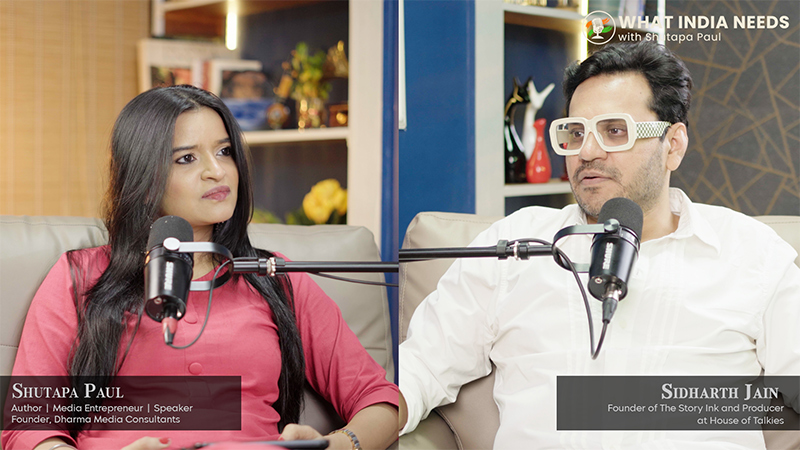
In the latest firecracker of an episode from the podcast What India Needs!, host and media entrepreneur Shutapa Paul sat down with content maven Sidharth Jain to lift the lid on Indian streaming’s messy midlife crisis.

Advertisement

Jain, the guy behind hit shows and sleepless nights for scriptwriters everywhere, joined Paul for a raw and revealing chat on what’s working, what’s worrisome, and what’s getting washed out in India’s $4.5 billion OTT pool – a figure projected to cannonball to $27.2 billion by 2033.

“The beauty of OTT is that there’s something for everyone,” Jain said, though he noted that grim, gritty narratives are slowly being benched in favour of feel-good, lighter content. Apparently, viewers want dopamine, not depression. And that shift is forcing creators to think pastel instead of pitch-black.

Paul took aim at censorship, calling out platforms for self-censoring and dodging anything remotely political. “Streaming platforms don’t want to commission or carry content which can be political or controversial,” she said. Jain didn’t disagree. “Why create something that could lead to legal battles and unnecessary trouble?” he added.

Advertisement

Under India’s IT Rules of 2021, platforms now navigate a vague maze of self-regulation, which has led to more red tape than revolution. Ambiguity is the enemy, and it’s pushing creators to pull punches before they’ve even picked up the pen.

So, is streaming still a playground for the underdog? Not quite. Jain threw shade on the idea of democratisation, noting how star-driven content and legacy studios have once again taken centre stage. “OTT was always about convenience… The real democratisation is happening on platforms like Youtube and social media, where anyone can create and share content,” he said.

In fact, OTT has started borrowing a page from the FMCG playbook. Star power is the new sugar, slick campaigns are the packaging, and your attention is the shelf space everyone wants. Jain pointed out that platforms now prefer faces that can light up billboards—and bring built-in followers to boot.

Advertisement

For those looking to break in, Jain offered a reality check, not a rose-tinted filter: “I would never recommend someone to enter this industry for an easy career. It’s easier to become a pilot or climb a mountain peak than find a sustainable career here.”

His advice?

Start scrappy.

Advertisement

Use Youtube.

Make short films.

Be consistent.

Advertisement

Be authentic.

And, above all, be ready to get punched in the creative gut before anything clicks.

The episode isn’t just a chinwag – it’s a crash course in surviving India’s streaming jungle. Jain and Paul unpack the evolution of OTT from a scrappy disruptor to a polished, star-backed machine that’s still figuring out where to go next. In a market with over 480 million OTT users and growing, the stakes – and expectations – are sky-high.

Advertisement

Watch link: https://open.spotify.com/episode/5yVct5K2dKP0VoMmtYtIBF?si=DEwz-r8xTwudBkrhqa7BHg 

Advertisement
Click to comment

Leave a Reply

Your email address will not be published. Required fields are marked *

AD Agencies

Omnicom Q4: Posts big revenue gains amid restructuring

Company trims underperforming units and launches $5B share buyback to reward investors.

Published

on

MUMBAI: Omnicom has decided that in the world of global advertising, it is better to be a big fish in an even bigger pond. The marketing powerhouse, which recently swallowed its rival IPG, has kicked off 2026 by showing the market that it is not just buying growth – it is engineering it. In a series of bold strategic manoeuvres, the group has doubled its projected cost-savings target to a whopping $1.5 billion over the next three years.

The fourth-quarter results for 2025, released on 18 February 2026, paint a picture of a company in the midst of a massive structural makeover. Reported revenue for the quarter shot up 27.9 per cent to $5,528.8 million, a figure heavily bolstered by the first full month of IPG’s operations under the Omnicom umbrella. For the full year, revenue reached $17,271.9 million, marking a 10.1 per cent increase as the company integrated heavyweights like Acxiom Real iD and Flywheel Commerce Cloud into its next generation Omni platform.

However, bigger does not always mean tidier. The group reported a Gaap net loss of $941.1 million for the final quarter, or $4.02 per diluted share. This was primarily due to a massive $1.1 billion bill for severance and real estate repositioning, alongside a $543.4 million loss on the sale of non-strategic businesses. When these one-off integration headaches are stripped away, the underlying performance looks far more robust, with adjusted net income reaching $607.7 million and earnings per share of $2.59, comfortably ahead of the prior year’s $2.41.

Advertisement

The group is also trimming the fat elsewhere. Management has identified underperforming and non-strategic units representing approximately $2.5 billion in revenue for exit or sale. Meanwhile, smaller majority-owned markets bringing in $700 million are being moved to minority positions. This portfolio pruning is designed to focus the New Omnicom on higher-growth areas like media, creative content, and data-driven consulting.

Investors, it seems, are being kept sweet with a significant return of capital. The board has approved a fresh $5 billion share repurchase program, initiating an immediate $2.5 billion accelerated buyback. This comes on top of $549.6 million paid out in common dividends during the year.

Performance across the sectors was a mixed bag but generally positive in the heavy-hitting divisions. Media and advertising revenue surged 34.4 per cent in the fourth quarter to $3,322.6 million, while public relations grew 12.4 per cent to $500.8 million. On the flip side, branding and retail commerce saw a 7.0 per cent dip. Regionally, the US remains the engine room, with revenue jumping 51.9 per cent to $2,869.1 million in the quarter, while the UK saw a respectable 18.8 per cent rise to $533.2 million.

Advertisement

With a total debt of $9.1 billion following the IPG acquisition, the group is leaning on its cash-generative nature to keep its investment-grade credit rating intact. Free cash flow for the year stood at $2,226.1 million, up from $1,964.7 million in 2024. As the company moves into 2026, the focus is firmly on the Connected Capability model, essentially ensuring that its global army of talent is pulling in the same direction, and more importantly, within a much leaner budget.

Continue Reading

Advertisement News18
Advertisement All three Media
Advertisement Whtasapp
Advertisement Year Enders

Copyright © 2026 Indian Television Dot Com PVT LTD