Digital
LS Digital announces partnership with .fearless

Mumbai – LS Digital has announced a new partnership with .fearless to launch .fear-LS. This joint venture aims to leverage the strengths of both the companies to solve the industry pain point of digital friction; an operational disconnect within the customer journey, and help businesses optimize their current systems and processes, significantly drive growth, and increase return on investment.
Many companies in the USA face digital friction, struggling to meet customer expectations and maximise revenue due to challenges within their systems. fear-LS addresses these issues by helping businesses across industries better understand their existing systems, identify underperforming areas, and implement strategies to streamline operations and enhance success. The U.S. market, known for its large-scale operations and a blend of traditional practices with openness to innovation, presents unique challenges and opportunities. With the rapid growth of the DBT category, LS Digital is poised to leverage this momentum to drive business success in this dynamic landscape.
The US market has been an early adopter of digital technologies, leading to robust foundational operations. This also presents challenges in integrating newer technologies to their legacy systems. “Technology has dramatically transformed the customer journey, leading to a significant rise in customer interactions with brands. However, digital friction within existing systems often drives customers away.” said Mike Head from .fearless. LS Digital’s well-established 6-pillar DBT framework, is uniquely positioned to deliver significant value to future-focused businesses. .fear-LS stands out in the market with differentiated services and in-house credibility to meet evolving customer needs. Speaking on this JV, Mike further added, “We are excited to partner with LS Digital, a leader in digital business transformation. Together, we will combine our unique insights and resources to help businesses create a seamless, results-driven digital presence that not only meets but exceeds customer expectations.”

77 per cent of businesses today say that consumer expectations have increased in the last year, but if companies have digital friction between their systems, they will be unable to meet increased expectations. By providing a comprehensive suite of services, .fear-LS provides companies with a roadmap to optimize and leverage digital processes and the executional capabilities for business transformation and increased return on investment.
There is a worldwide surge in companies embracing digital business transformation to eliminate friction and fuel growth. “Our focus is on delivering a product and service mix that stands out in the market. We build trust by connecting with the right customers and gaining a deep understanding of the new digital landscape, rather than just chasing revenue.” said LS Digital founder & CEO Prasad Shejale. Commenting on LS Digital’s global expansion, Prasad added, “Partnering with .fearless, a leader in marketing consultancy and industry veterans in the US market, aligns perfectly with our global ambitions. Through this joint venture, we are excited to bring our innovative DBT model, developed in India, for the world. Under the banner of .fear-LS, this partnership offers American businesses cutting-edge solutions to overcome digital friction and achieve sustainable growth.”





Digital
Global piracy networks evolve into multibillion-dollar crime syndicates
From bootleg DVDs to drug cartels, the new faces of organised crime are hiding in plain sight
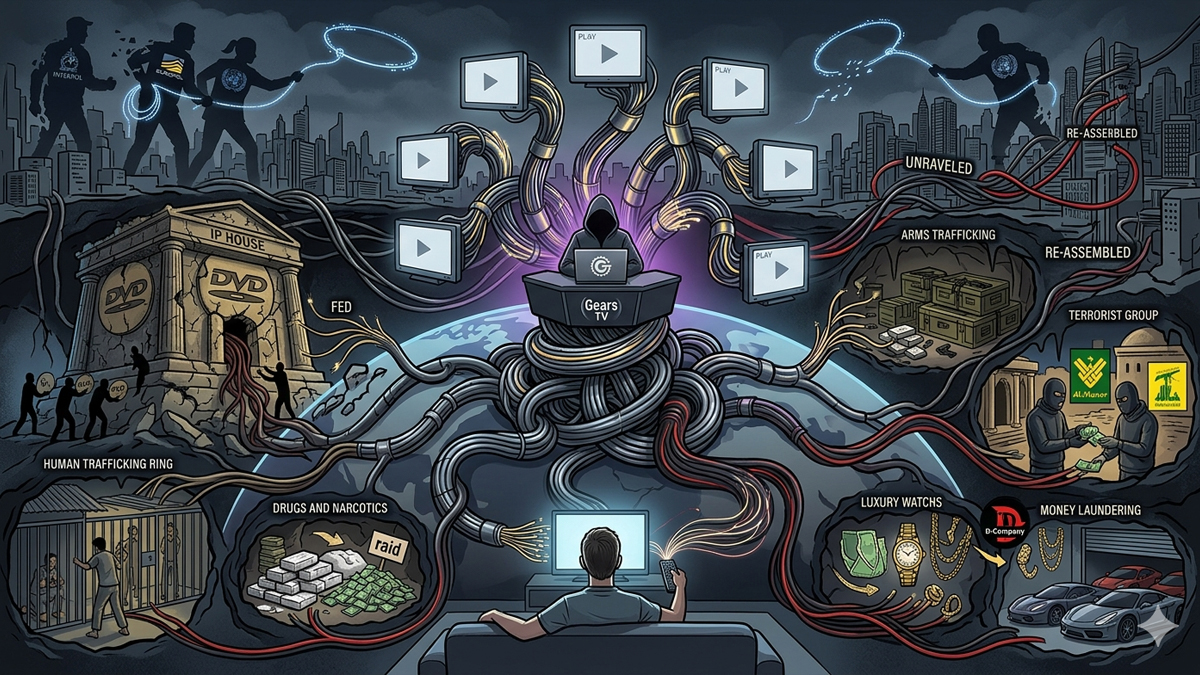
LONDON: Gone are the days of the local “dodgy DVD” man at the car boot sale. According to a landmark investigation by Digital Citizens Alliance and IP House, the world of digital piracy has undergone a chilling transformation into a sophisticated, multibillion-dollar ecosystem of organised crime. Far from being a victimless hobby, illicit streaming is now the “financial architecture” for global syndicates involved in everything from human trafficking and narcotics to funding international terrorism.
The joint report, titled “Organized. Piracy. Crime.”, reveals that modern piracy networks have ditched traditional hierarchies for a decentralized, digital-first model that is harder to track than a ghost in the machine. These groups use a “franchise model,” selling turnkey piracy kits, complete with streaming panels and content libraries, to operators worldwide, allowing the “CEOs” of these syndicates to remain anonymous while smaller cells take the heat.
In November 2024, European authorities dismantled a pay-TV network serving 22 million subscribers that generated a staggering $288 million (£230 million) per month. During raids across 11 countries, police seized not just servers and cryptocurrency, but a small army’s worth of drugs and firearms.
The crossover between digital theft and violent crime is no longer a theory. In Brazil, investigators found that piracy has become a “Plan B” for drug traffickers, providing low-risk, high-reward revenue to buy weapons and expand operations.
Operation fake (Spain): Exposed a syndicate combining content theft with property fraud, drug trafficking, and industrial-scale money laundering, resulting in 30 arrests and $12.7 million in frozen assets.
The “Hells Angels” connection: A Canadian investigation linked a piracy operator to members of the Hells Angels, noting he had previously been sentenced for cocaine smuggling.
Terrorist funding: Groups like Hezbollah and D-Company (led by global terrorist Dawood Ibrahim) have historically used piracy proceeds to fund their activities. Al-Manar, a banned terrorist television network, currently uses illegal IPTV services to bypass U.S. broadcast bans.
Perhaps most disturbing is the link to human exploitation. North East Regional Organised Crime Unit detective sergeant James Woodcock stated that “illegal streaming services… help fund wider organised crime such as human trafficking, child sexual exploitation, drug supply and other sinister crimes”.
In Southeast Asia, an estimated 220,000 people are being held in “polycriminal” compounds in Myanmar and Cambodia, forced to run cyber scams and potentially power the very IPTV panels used by Western viewers.
These syndicates have become masters of financial disguise, moving money faster than a 5G connection. Using shell companies, “hawala” informal payment systems, and cryptocurrency “mixing” services, they convert illegal subscriptions into luxury cars, real estate, and jewelry.
A prime example is the U.S. prosecution of IPTV mogul Bill Omar Carrasquillo (known as “Omi in a Hellcat”), whose Gears TV service generated tens of millions of dollars used to fund a lifestyle of luxury vehicles and commercial property.
Despite these networks meeting every international definition of organised crime set by the United Nations and Interpol, the report argues that authorities are currently “bringing a knife to a digital gunfight”.
The authors are urging governments to adopt stricter “site-blocking” laws, already used in over 50 countries, to cut off overseas criminals from domestic markets. As digital piracy generates an estimated $40 billion globally each year, the message is clear: if it operates like the mafia and launders like the mafia, it’s time to treat it like the mafia.
While the public in countries like Brazil and India (over 60 per cent) clearly see the link between piracy and organised crime, recognition in the UK and US remains lower. It seems the biggest hurdle to stopping these syndicates isn’t just technology, but the realization by consumers that their monthly “bargain” stream might be paying for someone else’s misery.