MAM
AAAI announces contest to redesign its logo


Mumbai: The Advertising Agencies Association of India (AAAI) on Tuesday announced a contest to redesign its logo to reflect the future of advertising and recast the descriptor ‘Advertising Agencies Association of India’ so as to showcase the evolving larger world of marketing communications. The contest is open to all creative individuals and advertising agencies.
The association also emphasised that the acronym AAAI (the three As of I) has a rich legacy and a fabulous brand recall which it does not want to tamper with.
AAAI also announced that the winner of the contest will be given a cash prize of Rs one lakh along with an all-expenses-paid trip for a team of two to attend Goafest 2022, which is scheduled between 5-7 May in Goa.

FCB Group India Group chairman and chairman of this contest Rohit Ohri said, ‘The advertising industry is facing its biggest transformation ever. The key question is not whether advertising will change, but how radically it will do so. It is high time that the AAAI identity changes to reflect this new direction being taken by the industry.”
“The present AAAI logo was designed in 2005, since then advertising has undergone a sea change and it is high time that we allow the next generation to take AAAI’s identity into the future,” AAAI president Anupriya Acharya said. “Keeping this in view, it was felt that AAAI should also forge a new identity which would reflect the current and future direction that the industry is taking.”
The last date for receiving entries of the designs is 15 April, said the statement.




Brands
Samsung certifies 1,000 Maharashtra students in AI and coding
The South Korean electronics giant marks its first large-scale skilling push in the state, with women making up nearly half the national programme’s enrolment
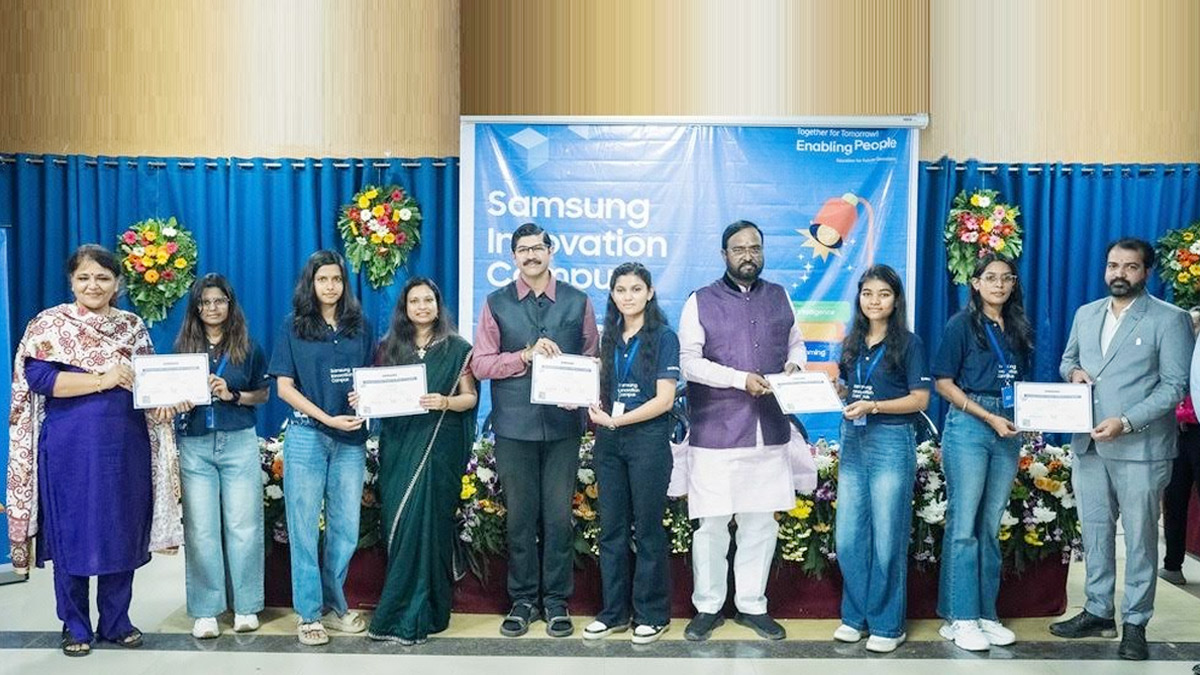
PUNE: Samsung has put 1,000 students in Maharashtra through a certified training programme in artificial intelligence and coding, the largest such drive the South Korean electronics company has run in the state and a signal that corporate India’s skilling ambitions are moving well beyond the boardroom brochure.
The certifications were awarded under Samsung Innovation Campus (SIC), the company’s flagship corporate social responsibility programme, which launched in India in 2022 with the stated aim of democratising access to future-technology education. The 1,000 graduates were drawn from four institutions: 127 from Savitribai Phule Pune University, 373 from Pimpri Chinchwad University, 250 from D.Y. Patil University’s Ramrao Adik Institute of Technology and 250 from Anjuman-I-Islam’s Kalsekar Technical Campus. All completed training in either AI or coding and programming, the two disciplines Samsung has identified as the critical pillars of the digital economy.
The programme does not stop at technical training. Soft-skills development and career-readiness modules are baked into the curriculum, a deliberate attempt to close the gap between what universities teach and what employers actually want.
“India’s digital growth story will ultimately be shaped by the quality of its talent pipeline,” said Shubham Mukherjee, head of CSR and corporate communications at Samsung Southwest Asia. “As technologies like AI move from the periphery to the core of industries, skilling must evolve from basic training to building real-world capability. This milestone in Maharashtra reflects how industry and academia can come together to create a future-ready workforce that is both globally competitive and locally relevant.”
The Maharashtra drive sits within a rapidly scaling national effort. Samsung Innovation Campus trained 20,000 young people across India in 2025, hitting its stated target for the year. Women account for 48 per cent of national enrolments, a figure the company cites as evidence of its push for an inclusive technology ecosystem. The programme is implemented in partnership with the Electronics Sector Skills Council of India and the Telecom Sector Skill Council.
Samsung, which is marking 30 years in India this year, runs SIC alongside two other initiatives, Samsung Solve for Tomorrow and Samsung DOST, as part of a broader effort to build what it calls a generation of innovators with both the technical depth and the problem-solving mindset to thrive in a fast-moving digital world.
A thousand certified students is a tidy headline. Whether they find jobs that match their new skills is the harder question, and the one that will ultimately determine whether corporate skilling programmes like this one are genuine pipelines or well-photographed gestures.






