iWorld
Formula E and SABIC’s GENBETA Car sets Guinness World Record title

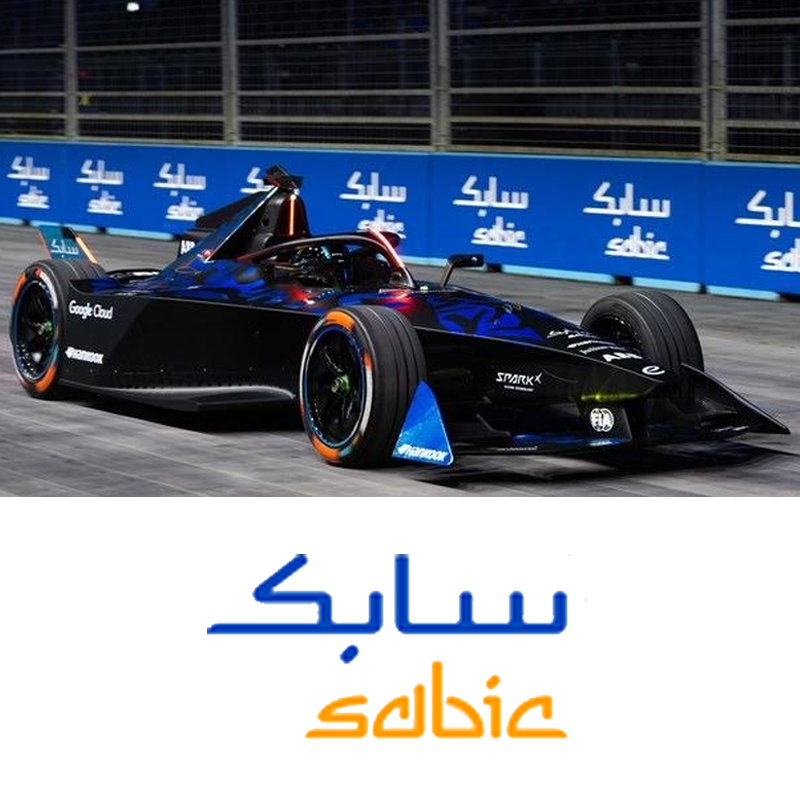
Mumbai: SABIC, a global leader in diversified chemicals, formally highlighted the use of its materials in applications on the GENBETA car, the new holder of the GUINNESS WORLD RECORDS title for the fastest speed achieved by a vehicle indoors revealed and is now on display at the 2023 Hankook London E-Prix from today.
The GENBETA car was pushed to the limit by ABB FIA Formula E World championship drivers Jake Hughes (NEOM McLaren Formula E Team) and Lucas di Grassi (Mahindra Racing) in the Duals format used to qualify for Formula E races.
Jake Hughes hit a top speed of 218.71KPH, setting a new world record. The vehicle is part of the GENBETA live development and innovation project, which aims at exploring new materials and technologies for future EV race and road cars.

Leveraging application development expertise and material science, SABIC supported the design and development of innovative parts of the GENBETA car, which is based on the GEN3 car, helping and enabling the creation of the fastest, lightest, and most powerful and efficient electric car, reinforcing the company’s ambition to accelerating the world’s shift to electrification and carbon neutrality.
SABIC’s role in the GENBETA program and integration in the car forms part of the company’s collaborative innovation partnership with the world’s first all-electric FIA World Championship.
The materials from SABIC integrated into applications of the GENBETA car are highly engineered thermoplastics that enable design freedom through their inherent processing moldability compared to most other materials. Such thermoplastics can help enhance the car’s aerodynamics, contributing to its acceleration and speed performance.
The relevant applications include:
Front wing endplates – These elements, formed using an additive manufacturing or 3D printing process known as fused deposition modelling, are mounted on the outboard extremities of the vehicle’s front wing. They are integral to a redirection of airflow around the front wheels to help reduce drag while contributing to the car’s downforce and stability.
Wheel fins – These components are manufactured through injection moulding with SABIC’s sustainable mechanically-recycled thermoplastics from the portfolio of TRUCIRCLETM circular materials. These parts are mounted onto the wheel rims in a radial, spoke-like pattern, and are intended to help optimize airflow and reduce aerodynamic drag for higher acceleration and speed performance. As an additional benefit, the fins can increase the car’s overall efficiency and aid in cooling the brakes to improve stopping power.
Wind deflector – This transparent part is a coated thermoplastic sheet product, manufactured through an extrusion process using a bio-renewable, low-carbon material from the TRUCIRCLE portfolio. The component is attached to the front of the cockpit, ahead of the driver, and supports optimization of airflow for decreased drag – again, contributing to improved speed performance.
As SABIC collaborates with Formula E and its partners, it is drawing on a still-expanding portfolio of thermoplastics developed under dedicated solution platforms for electrification (BLUEHERO), and the circular economy (TRUCIRCLE).
First announced as the electric racing series Principal and Innovation Partner in 2022, SABIC intends to continue to work closely with Formula E to develop cutting-edge solutions that will help drive further innovation in electric vehicle technologies and progress in sustainable practices across the sport’s wider ecosystem and operations.
As part of its presence at the London E-Prix, SABIC participated in Formula E’s sustainable innovations summit – Change. Accelerated. Live. – where they discussed in ‘The Power of Prototypes’ panel discussion the advantages that development projects like the GENBETA bring to the EV industry and the world.

Gaming
Bluestone FY26 revenue rises to Rs 2,436 crore, turns profitable
Q4 profit at Rs 31 crore, full-year profit at Rs 13 crore vs loss last year.

MUMBAI: From sparkle to numbers, Bluestone seems to be polishing more than just jewellery this year. Bluestone Jewellery and Lifestyle Limited reported a sharp turnaround in FY26, with revenue from operations rising to Rs 2,436 crore (Rs 24,364 million), up from Rs 1,770 crore (Rs 17,700 million) in FY25. The company posted a full-year profit of Rs 13 crore (Rs 131.79 million), a significant recovery from a loss of Rs 222 crore (Rs 2,218 million) a year ago.
Total income for the year stood at Rs 2,486 crore (Rs 24,860 million), compared to Rs 1,830 crore (Rs 18,300 million) in the previous year, reflecting both topline growth and improved operational momentum.
The March quarter, however, told a more nuanced story. Revenue from operations came in at Rs 681 crore (Rs 6,814 million), down from Rs 748 crore (Rs 7,486 million) in the year-ago period, though higher than Rs 461 crore (Rs 4,613 million) in the preceding December quarter. Net profit for Q4 stood at Rs 31 crore (Rs 311.81 million), compared to Rs 68 crore (Rs 688 million) a year earlier, but a clear reversal from a loss of Rs 51 crore (Rs 512 million) in Q3.
Margins were shaped by higher input costs, with raw material consumption rising to Rs 2,204 crore (Rs 22,043 million) for the full year, alongside employee benefit expenses of Rs 282 crore (Rs 2,824 million) and finance costs of Rs 210 crore (Rs 2,104 million). Other expenses came in at Rs 371 crore (Rs 3,715 million), slightly lower than Rs 393 crore (Rs 3,938 million) in FY25.
On the balance sheet front, total assets expanded to Rs 4,961 crore (Rs 49,610 million) as of March 31, 2026, from Rs 3,532 crore (Rs 35,322 million) a year earlier, driven largely by a surge in inventories to Rs 2,672 crore (Rs 26,718 million). Equity also strengthened to Rs 1,803 crore (Rs 18,030 million), nearly doubling from Rs 911 crore (Rs 9,107 million).
Cash flows reflected the cost of growth. Net cash used in operating activities stood at Rs 199 crore (Rs 1,990 million), while investing activities saw an outflow of Rs 239 crore (Rs 2,392 million). Financing activities, however, generated Rs 497 crore (Rs 4,971 million), helping the company end the year with cash and cash equivalents of Rs 108 crore (Rs 1,075 million), up from Rs 49 crore (Rs 487 million).
Earnings per share for FY26 came in at Rs 1.10, a sharp improvement from a negative Rs 79.74 in FY25, underlining the shift from losses to profitability.
With revenue scaling up, costs still glittering on the higher side, and profitability finally back in the black, BlueStone’s FY26 performance suggests a business mid-transition less about shine alone, and more about sustaining it.