Brands
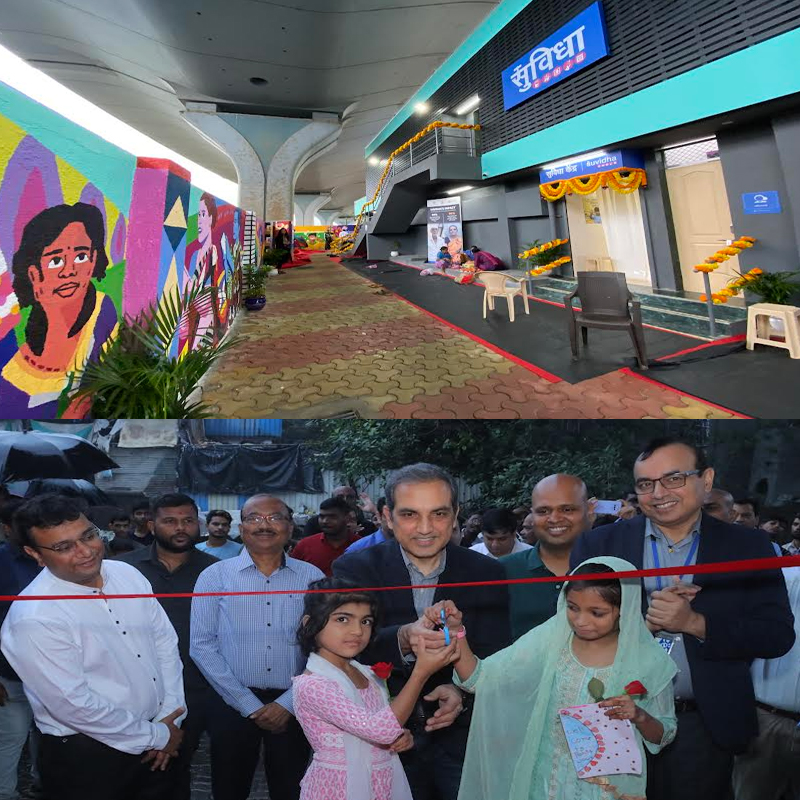
HUL and HSBC launch new Suvidha Centre, empowering Dharavi community
Mumbai: Hindustan Unilever Limited (HUL) along with HSBC India announced the launch of the 14th Suvidha Centre in partnership with the BMC (Brihanmumbai Municipal Corporation).
Suvidha centres are a one-stop solution for meeting the hygiene and sanitation requirements of low-income communities by providing them with access to clean toilets, purified drinking water, showers and laundry services. Launched in 2016, there are 14 such centres in Mumbai, equipped with over 550 toilet seats. This initiative is the result of a pioneering public-private partnership of HUL, HSBC India and the BMC and it positively impacts the lives of over 350,000 people each year.
Emphasizing inclusivity and safety, these centres are designed to prioritize the well-being of women and children, incorporating features such as ample lighting, security cameras, and an emergency panic button system. Additionally, these centres save over 100 million litres of water cumulatively through greywater treatment and recycling.
Furthermore, over 98 per cent of women find Suvidha to be safe, with 75 per cent of women users reporting that Suvidha has saved them time, allowing for better quality time with their families. Additionally, 91 per cent of users have attested to Suvidha’s positive impact on their self-esteem, according to an external impact assessment study.
HUL CEO & managing director Rohit Jawa said, “The state-of-the-art Suvidha Centres foster holistic health and wellbeing of all citizens by providing them affordable access to safe toilets, clean drinking water, showers and laundry services. With the expansion of the Suvidha Model in Dharavi (a total of three now), we, along with our partners BMC and HSBC India, remain committed to transforming community hygiene and sanitation services for all.”
HSBC India general manager & CEO Hitendra Dave said, “The expansion of the Suvidha model in Dharavi is a significant milestone in our partnership with HUL and BMC. It enables us to provide and transform hygiene and sanitation services for those who have limited or no access to sanitation facilities in Mumbai. We are happy to be able to contribute towards addressing urban sanitation issues in densely populated areas like Dharavi. We remain committed to various causes of community development and look forward to working with like-minded partners for the greater benefit of the society.”

Brands
Microsoft faces worst quarter since 2008 financial crisis
Cloud giant battles soaring AI costs and fierce competition from nimble startups.
MUMBAI: When the tech titan starts looking a little wobbly, even the Magnificent Seven can feel the tremors because Microsoft is currently starring in its own sequel, “Clouds and Doubts.” Microsoft is on track for its worst quarterly performance since the 2008 global financial crisis, according to Bloomberg, as investors grow increasingly uneasy about rising capital expenditure and intensifying competition from nimble AI firms. The company has been pouring money into AI infrastructure, yet markets are questioning when these hefty investments will finally deliver stronger revenue growth.
At the same time, investors are shifting away from traditional software stocks amid fears that AI startups such as Anthropic and OpenAI are developing autonomous agents capable of replacing established products, including those from Microsoft. Jonathan Cofsky, portfolio manager at Janus Henderson Investors, noted growing concern that customers may bypass Microsoft and deal directly with AI vendors, potentially disrupting its core business and putting pressure on pricing and margins.
Microsoft’s stock has tumbled 25 per cent in the first quarter, putting it on course for its largest drop since a 27 per cent fall in the fourth quarter of 2008. It has also emerged as the weakest performer among the so-called Magnificent Seven technology stocks, while a broader index tracking the group has fallen 14 per cent over the same period. The shares slipped a further 1.7 per cent after markets opened on Friday, marking a potential fourth consecutive session of declines.
Cofsky pointed out that Microsoft has become more capital intensive and that improved investor confidence will hinge on assurances that software growth will not slow materially. Despite the sell-off, the stock is now trading at less than 20 times projected earnings over the next 12 months, its lowest valuation level since June 2016. Its valuation remains slightly above that of the S&P 500 Index, although it has recently traded at a discount to the broader benchmark for the first time since 2015.
Bloomberg data shows Microsoft’s capital expenditure, including leases, is expected to surge to $146 billion in fiscal 2026, up around 66 per cent from $88 billion in fiscal 2025. Spending is projected to climb further to $170 billion in fiscal 2027 and $191 billion in fiscal 2028, based on average estimates. Investors are growing cautious about such levels of spending without clearer signs of stronger growth.
Microsoft’s Azure cloud division has reported a slight slowdown in growth compared with the previous quarter, while its Copilot AI product has seen limited user traction, prompting internal changes aimed at improving performance. Ben Reitzes, an analyst at Melius Research, warned in a March note that Microsoft’s upside in Azure could be constrained as the company works to address challenges related to its AI models and Copilot offering, adding that these issues are unlikely to be resolved in the short term.
Of the 67 analysts covering Microsoft, 63 maintain buy ratings, three hold ratings and one a sell rating. The average 12-month price target of $592 implies a potential upside of more than 64 per cent, the highest on record based on data going back to 2009. The stock is also trading below its 200-day moving average by the widest margin since 2009.
Reitzes suggested the dominance of buy ratings may indicate complacency among analysts, while highlighting risks in Microsoft’s productivity and business processes segment as well as its More Personal Computing division. In contrast, Tal Liani of Bank of America reinstated coverage with a buy rating, citing durable multi-year growth prospects across cloud and AI. Jake Seltz, portfolio manager at Allspring Global Investments, maintained that Microsoft retains strong long-term value and that its AI strategy is likely to be validated over time, viewing near-term concerns as a potential opportunity for longer-term investors.
The report highlights a growing divergence in market sentiment, with optimism around long-term AI potential weighed against immediate execution risks and investor uncertainty. In the world of big tech, even the mightiest clouds can have silver linings but right now, Microsoft’s investors are scanning the horizon for clearer skies.