iWorld
WARC flags shift to ‘small comforts’ amid global uncertainty
Report finds 45 per cent fear job loss, 78 per cent want AI labels
MUMBAI: When wallets tighten, comfort loosens the purse strings and brands are racing to keep up. A new 2026 Global Consumer Trends Report by WARC paints a picture of cautious consumers navigating financial strain and geopolitical unease, while quietly splurging on “small comforts” that deliver emotional relief. Backed by global surveys from GWI and WARC’s own analysis, the study maps five forces reshaping how and why people spend.
At the heart of it is a paradox, anxiety is up, but so is the appetite for joy. Nearly 45 per cent of employed consumers worry about job security, while one-third are either cutting back or saving more. Yet, instead of shutting their wallets entirely, many are redirecting spending towards low-cost indulgences think wellness, hobbies, and everyday experiences that feel like mini escapes.
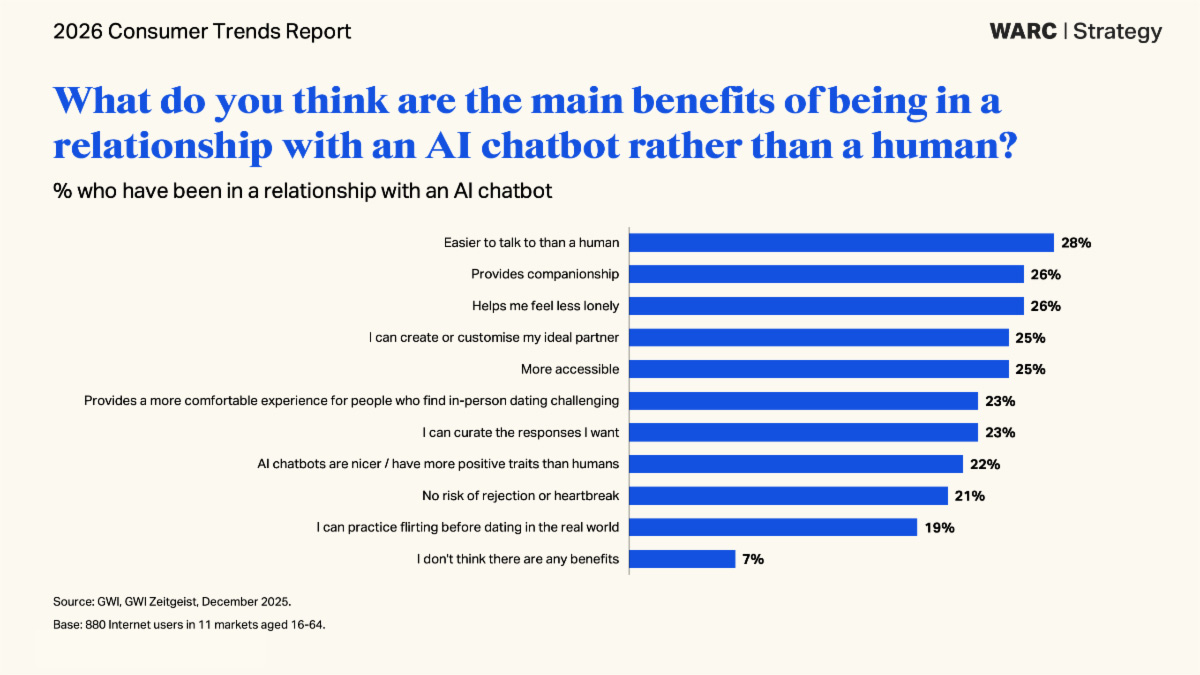
Artificial intelligence is adding a new twist to human connection. The report finds that one in ten consumers globally has been in a relationship with an AI chatbot, signalling a shift from tool to companion. While this opens doors for AI-led products and services, it also raises fresh questions around ethics and safety.
Meanwhile, social media is facing a credibility crunch especially among younger audiences. Around 64 per cent of consumers believe social platforms are harmful to children, fuelling calls for stricter regulations and age checks. For brands, this could mean rethinking youth engagement strategies and building more controlled, trust-led ecosystems.
Perceptions of global manufacturing are shifting too. ‘Made in China’ is shedding its purely price-driven image, with 36 per cent of consumers now associating Chinese products with innovation. One in four consumers even prefer buying electronics from China, pointing to a growing value-over-cost mindset.
And as AI-generated content floods feeds, authenticity is emerging as the new currency. A striking 78 per cent of consumers say such content should be clearly labelled, underscoring a rising demand for transparency in an increasingly synthetic digital world.
As Stephanie Siew, Senior Research Executive at WARC, notes, consumer sentiment remains fragile but opportunity-rich. The takeaway is clear: in a world of uncertainty, brands that balance emotional resonance with trust and transparency may find themselves not just surviving but sticking.

Gaming
Bluestone FY26 revenue rises to Rs 2,436 crore, turns profitable
Q4 profit at Rs 31 crore, full-year profit at Rs 13 crore vs loss last year.
MUMBAI: From sparkle to numbers, Bluestone seems to be polishing more than just jewellery this year. Bluestone Jewellery and Lifestyle Limited reported a sharp turnaround in FY26, with revenue from operations rising to Rs 2,436 crore (Rs 24,364 million), up from Rs 1,770 crore (Rs 17,700 million) in FY25. The company posted a full-year profit of Rs 13 crore (Rs 131.79 million), a significant recovery from a loss of Rs 222 crore (Rs 2,218 million) a year ago.
Total income for the year stood at Rs 2,486 crore (Rs 24,860 million), compared to Rs 1,830 crore (Rs 18,300 million) in the previous year, reflecting both topline growth and improved operational momentum.
The March quarter, however, told a more nuanced story. Revenue from operations came in at Rs 681 crore (Rs 6,814 million), down from Rs 748 crore (Rs 7,486 million) in the year-ago period, though higher than Rs 461 crore (Rs 4,613 million) in the preceding December quarter. Net profit for Q4 stood at Rs 31 crore (Rs 311.81 million), compared to Rs 68 crore (Rs 688 million) a year earlier, but a clear reversal from a loss of Rs 51 crore (Rs 512 million) in Q3.
Margins were shaped by higher input costs, with raw material consumption rising to Rs 2,204 crore (Rs 22,043 million) for the full year, alongside employee benefit expenses of Rs 282 crore (Rs 2,824 million) and finance costs of Rs 210 crore (Rs 2,104 million). Other expenses came in at Rs 371 crore (Rs 3,715 million), slightly lower than Rs 393 crore (Rs 3,938 million) in FY25.
On the balance sheet front, total assets expanded to Rs 4,961 crore (Rs 49,610 million) as of March 31, 2026, from Rs 3,532 crore (Rs 35,322 million) a year earlier, driven largely by a surge in inventories to Rs 2,672 crore (Rs 26,718 million). Equity also strengthened to Rs 1,803 crore (Rs 18,030 million), nearly doubling from Rs 911 crore (Rs 9,107 million).
Cash flows reflected the cost of growth. Net cash used in operating activities stood at Rs 199 crore (Rs 1,990 million), while investing activities saw an outflow of Rs 239 crore (Rs 2,392 million). Financing activities, however, generated Rs 497 crore (Rs 4,971 million), helping the company end the year with cash and cash equivalents of Rs 108 crore (Rs 1,075 million), up from Rs 49 crore (Rs 487 million).
Earnings per share for FY26 came in at Rs 1.10, a sharp improvement from a negative Rs 79.74 in FY25, underlining the shift from losses to profitability.
With revenue scaling up, costs still glittering on the higher side, and profitability finally back in the black, BlueStone’s FY26 performance suggests a business mid-transition less about shine alone, and more about sustaining it.