Brands
Adani Airport Holdings and Blinkit launch India’s first in-terminal quick commerce service at Mumbai’s Terminal 2
Passengers at Chhatrapati Shivaji Maharaj International Airport can now order essentials on the Blinkit app and have them delivered within minutes
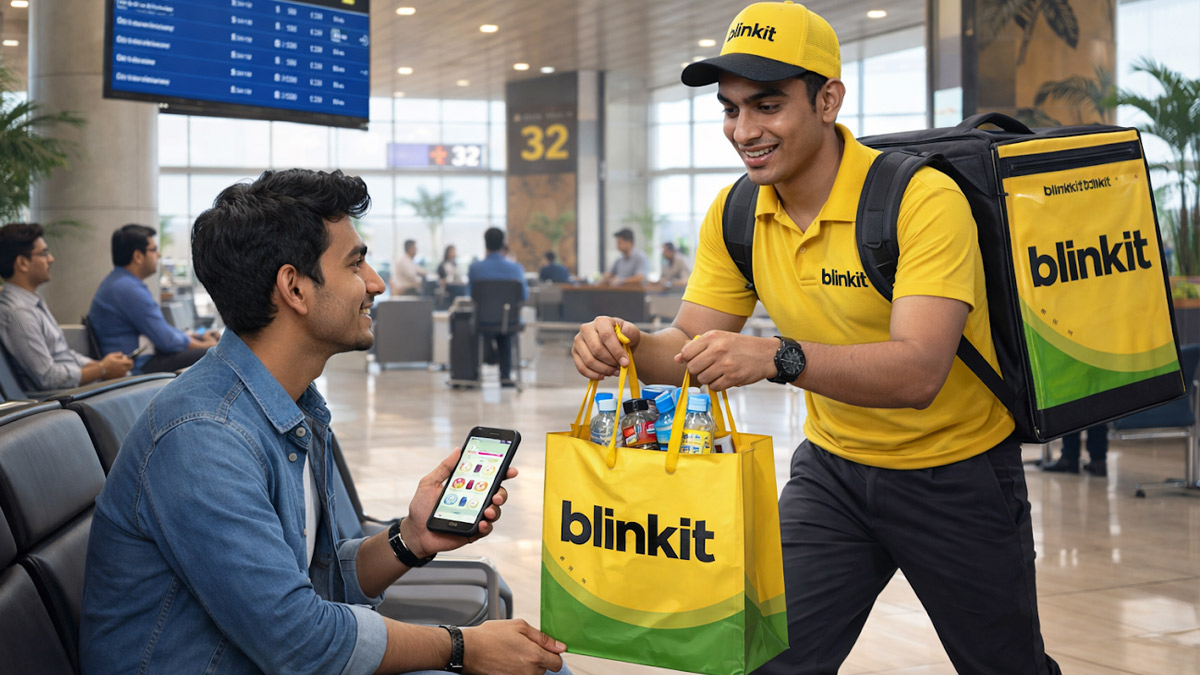
MUMBAI: Forget the overpriced airport shop. Travellers rushing through departures at Mumbai’s Chhatrapati Shivaji Maharaj International Airport can now order essentials on their phones and have them delivered within minutes, right to their gate.
Adani Airport Holdings Limited, India’s largest private airport operator, has partnered with quick commerce platform Blinkit to launch what the two companies claim is India’s first in-terminal quick commerce service. The service is live at Terminal 2, domestic departures, and allows passengers to order through the Blinkit app for delivery anywhere within the terminal, including boarding gates, lounges, the food court and select partner outlets. Deliveries are handled by trained on-ground personnel, ensuring a seamless experience without disrupting travel timelines.
The product range covers travel accessories, electronics, snacks, books, baby care and personal essentials. Permissible liquids including packaged water, cold beverages and juices are sourced from approved in-terminal inventory, in line with airport security protocols.
An AAHL spokesperson said the initiative was part of a broader push to reimagine digital services at airports. “Bringing app-based convenience into the terminal allows passengers to make better use of their time and raises the overall service standard,” the spokesperson said, describing it as a step towards building “more responsive and passenger-centric airports.”
For Blinkit, the tie-up extends quick commerce into a high-frequency, high-intent environment. For AAHL, it reflects a strategic push to grow non-aeronautical revenue through digitally enabled retail, a increasingly important revenue stream for airport operators worldwide.
You are already late for your flight. At least now you do not have to be thirsty too.

Brands
Dunkin’ Donuts to exit India as Jubilant FoodWorks ends 15-year franchise deal
The quick service restaurant giant is ending a 15-year franchise partnership with the American doughnut chain, even as it renews its Domino’s agreement for another 15 years
NOIDA: Dunkin’ is done in India. Jubilant FoodWorks Ltd, the country’s leading quick service restaurant operator, has decided not to renew its franchise agreement with the American coffee and doughnut chain, and will wind down its Indian stores in a phased manner before December 31, 2026, bringing a 15-year partnership to a quiet, loss-laden close.
The decision, approved by JFL’s board on March 30, 2026, ends a relationship that began with a Multiple Unit Development Franchise Agreement signed on February 24, 2011. JFL will now evaluate and undertake what it described in a regulatory filing as the “rationalisation and/or cessation of certain operations and/or sale, transfer or disposal of assets and/or assignment or transfer of franchise rights,” all in consultation with Dunkin’s brand owners and strictly within the terms of the original agreement.
The numbers tell the story bluntly. In the financial year 2024-25, Dunkin’ India posted a revenue of Rs 37 crore against a loss of Rs 19 crore — a haemorrhage that was always going to test the patience of a parent company recording revenues of Rs 6,104 crore and a profit of Rs 194 crore in the same period. Doughnuts, it turns out, were never going to move the needle.
The contrast with JFL’s handling of its other marquee franchise could hardly be sharper. Even as it walks away from Dunkin’, the company has just doubled down on Domino’s, signing a fresh Master Franchise Agreement on March 31, 2026, granting it exclusive rights to develop and operate Domino’s Pizza stores in India for 15 years, with an option to renew for a further 10.
JFL, incorporated in 1995 and promoted by the Bharatia family, operates a network of more than 3,500 stores across six markets — India, Turkey, Bangladesh, Sri Lanka, Azerbaijan and Georgia. Its portfolio includes Domino’s and Popeyes on the global side, and two home-grown brands: Hong’s Kitchen and COFFY, a café brand in Turkey.
For Dunkin’, India was always a stretch. The brand never quite cracked the cultural code in a market where filter coffee and chai command fierce loyalty and where the doughnut remains, at best, an occasional indulgence rather than a daily habit. Fifteen years, mounting losses and a parent with better things to spend its capital on was always going to be a difficult equation to solve.
The doughnut has had its last day. The pizza, however, is staying.