MAM
Painted in glory Berger turns 50 years of superstardom into murals

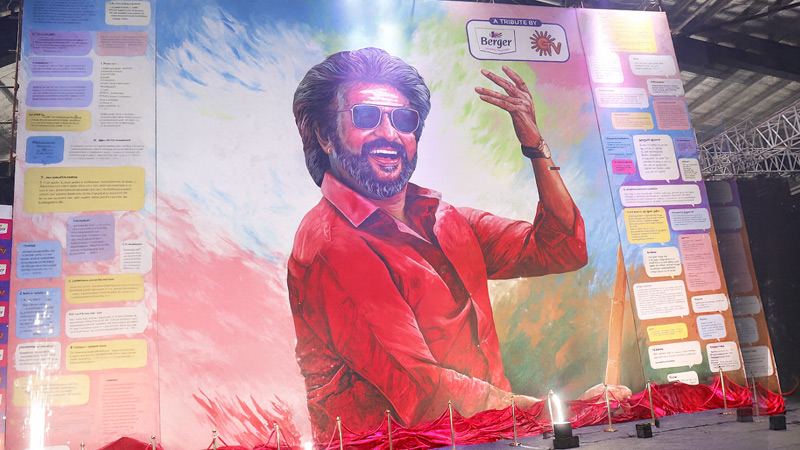
MUMBAI: Some jubilees call for speeches. This one called for a fresh coat of legend. Berger Paints India, in collaboration with Sun TV, has marked a superstar’s 50 glittering years in cinema by trading red carpets for murals, unveiling a sweeping artistic tribute that blends fandom, film history and colour on a monumental scale.
Titled 50 Years of Stardom, the showcase brings together 50 vibrant murals, anchored by a striking 40-foot Master Mural, to celebrate a career that has spanned five decades and multiple generations of moviegoers. From his early screen appearances to his status as a cultural constant, the tribute traces a journey defined by reinvention, mass appeal and enduring relevance.
The centrepiece was unveiled at the VELS Trade & Convention Centre in Chennai, where leading film personalities gathered to reveal a mural that does more than depict iconic moments. Embedded within it are 50 messages sourced from fans across India, each reflecting personal memories, favourite roles and the emotional imprint of a career that has crossed regional and national boundaries.

Alongside the Master Mural, a curated gallery of artworks revisits the superstar’s most memorable on-screen eras, capturing shifts in style, persona and storytelling through bold colours and visual motifs inspired by Tamil Nadu’s cultural fabric.
The project also leans into scale. After its Chennai debut, the murals will travel across Tamil Nadu as part of a “Mural Yatra”, supported by Berger Paints’ retail network. The idea is to take the celebration beyond galleries and venues, bringing it directly into neighbourhoods and public spaces across the state.
The initiative has drawn participation from across Berger Paints’ ecosystem, with more than 2,000 dealers, over 22,000 applicators and 1,000-plus engineers involved in what the company describes as an industry-first effort.
For Berger Paints, which marks 100 years in India, the parallel is deliberate. A century-old brand celebrating a 50-year cinematic journey underscores a shared narrative of longevity, evolution and trust built over time.
As the murals set off on their state-wide journey, the message is clear: some legacies are best remembered not just on screen, but painted large enough for an entire generation to walk past, pause and look up.




Digital
Content India 2026 opens with a copro pitch, a spice evangelist and a £10,000 prize for Indian storytelling
Dish TV and C21Media’s three-day summit puts seven ambitious projects before an international jury, and two walk away with serious development money
MUMBAI: India’s content industry gathered in Mumbai this March for Content India 2026, a three-day summit organised by Dish TV in partnership with C21Media, and it wasted no time making a statement. The event opened with a Copro Pitch that put seven scripted and unscripted television concepts before an international panel of judges, and by the end of it, two projects had walked away with £10,000 each in marketing prize money from C21Media to support development and international promotion.
The jury, comprising Frank Spotnitz, Fiona Campbell, Rashmi Bajpai, Bal Samra and Rachel Glaister, evaluated a shortlist that ranged from a dark Mumbai comedy-drama about mental health (Dirty Minds, created by Sundar Aaron) to a Delhi coming-of-age mystery (Djinn Patrol, by Neha Sharma and Kilian Irwin), a techno-thriller about a teenage gaming prodigy (Kanpur X Satori, by Suchita Bhatia), an investigative crime drama blending mythology and modern thriller (The Age of Kali, by Shivani Bhatija), a documentary on India’s spice heritage (The Masala Quest, hosted by Sarina Kamini), a documentary on competitive gaming (Respawn: India’s Esports Revolution, by George Mangala Thomas and Sangram Mawari), and a reality-horror competition merging gaming and immersive fear (Scary Goose, by Samar Iqbal).
The session was hosted by Mayank Shekhar.
The two winners were Djinn Patrol, backed by Miura Kite, formerly of Participant Media and known for Chinatown and Keep Sweet: Pray & Obey, with Jaya Entertainment, producers of Real Kashmir Football Club, also attached; and The Masala Quest, created and hosted by Sarina Kamini, an Indian-Australian cook, author and self-described “spice evangelist.”
The summit also unveiled the Content India Trends Report, whose findings made for bracing reading. Daoud Jackson, senior analyst at OMDIA, set the tone: “By 2030, online video in India will nearly double the revenue of traditional TV, becoming the main driver of growth.” He noted that in 2025, India produced a quarter of all YouTube videos globally, overtaking the United States, while Indians collectively spend 117 years daily on YouTube and 72 years on Instagram. Traditional subscription TV is declining as free TV and connected TV gain ground, forcing broadcasters to innovate. “AI-generated content is just 2 per cent of engagement,” Jackson added, “highlighting the dominance of high-quality human content. The key for Indian media companies is scaling while monetising effectively from day one.”
Hannah Walsh, principal analyst at Ampere Analysis, added hard numbers to the picture. India produced over 24,000 titles in January 2026 alone, with 19,000 available internationally. The country now accounts for 12 per cent of Asia-Pacific content spend, up from 8 per cent in 2021, outpacing both Japan and China. Key exporters include JioStar, Zee Entertainment, Sony India, Amazon and Netflix, delivering over 7,500 Indian-produced titles abroad each year. The top importing markets are Saudi Arabia, the UAE, Egypt, the United States and the Philippines. Scripted content dominates globally at 88 per cent, with crime dramas and children’s and family titles performing particularly strongly.
Manoj Dobhal, chief executive and executive director of Dish TV India, framed the summit’s ambition squarely. “Stories don’t need translation. They need a platform, discovery, and reach, local or global,” he said. “India produces more movies than any country, our streaming platforms compete globally, and our tech and creators win international awards. Yet fragmentation slows growth. Producers, platforms, and tech move in different lanes. We need shared spaces, collaboration, and an ecosystem where ideas, technology, and people meet. That is why we built Content India.”
The data, the pitches and the prize money all pointed to the same conclusion: India is not waiting for the world to discover its stories. It is building the infrastructure to sell them.







