Cable TV
Mumbai cable ops reject compromise formula

NEW DELHI/MUMBAI: Even as the Indian government today continued its efforts to convince the media and critics that everything is hunky-dory on the conditional access front, the Mumbai cable operators and cable distributors joined issue with their Delhi counterparts in denouncing a move to price cable services at Rs 72 during an interim period when an area-wise rollout is done.
The government also today clarified that the cable service price of Rs 72 per month for the non-CAS enabled areas in the four metros would continue till the time the metros become fully become CAS-enabled.
According to Sonali Cable proprietor and spokesperson of CODA (Mumbai Cable Operators and Distributors’ Association) Suvarna G Amonkar, “The association of Mumbai cable operators and distributors has rejected the move to price cable services at Rs 72 during the interim period. Mumbai based operators have joined forces with Delhi based cable operators to fight the nexus between broadcasters and MSOs.”
On Saturday, the Delhi-based Cable Operators United Front (COUF) had rejected the so-called truce called by the broadcasters and the MSOs at the instance of the government.
Even as this was happening, Zee Telefilms chairman and managing director Subhash Chandra today told CNBC India-TV 18 business news channel that as per his estimates there would be sizeable demand for the set top boxes in the metros.
Cable fraternity continues to be divided
Though some cable operators in Mumbai and Delhi have protested a government-supported move to go in for area-wise rollout of CAS in the four metros, to be completed by 1 December, another section has supported the move.
In a letter to the Prime Minister’s Office (PMO) and a key official there, Sudheendra Kulkarni, Shiv Sena Vibhag Pramukh and Dattatray Cable proprietor Anil Parab, a CAS taskforce member, has highlighted the following concerns:
1) The price of Rs 72 per month would put financial pressure on cable operators as they will not be able to meet the operational expenses such as network maintenance and salaries of staff. The government must notify that the cable operators can charge at the old rates existing as of 31 December 2002, in sync with the Mumbai high court interim order.
2) This problem will be compounded if the CAS implementation deadline is further extended due to delaying tactics adopted by broadcasters or MSOs.
3) If the government issues a notification on Rs 72 per month, the Mumbai HC that is scheduled to hear the cable case on 23 July might be influenced to pass a judgement on similar lines. Then, cable operators will not be able to properly collect dues for an entire year starting January 2003 and won’t be able to pay MSOs who, in turn, won’t be able to settle dues with broadcasters. Already, broadcasters have threatened to disconnect if all past dues are not settled by end July.
The Delhi-based COUF had, of course, termed the whole truce effort “shocking and disappointing”, especially as there was no complete and true representation of cable operators at the meeting where the compromise formula — with riders from broadcasters — was evolved.
Pointing out that the price of Rs 72 for the basic tier, termed as the service charges, is too low, COUF president Virendra Gaur had warned that “there will be no cable television in these four metro post CAS if the viability of the last mile operator is not taken into consideration.”
Gaur’s poser to the government: “How can a government neglect the interest of lakhs of poor self-employed citizens and help some big houses or foreign companies to grow on the bodies of some poor people?”
But the counterpoint to all these arguments come from the likes of Roop Sharma, Vikki Chowdhry and Rakesh Dutta of the Cable Operators Federation of India, National Cable and Telecom Association and Cable Networks Association, respectively. Most cable ops, aligned to them, have welcomed the compromise formula despite having to take a hit of Rs 500 million per month. This is contrary to the broadcasters’ claims that the cable ops would take a hit of up to Rs 2 billion.
According to them, the compromise formula hammered out by the PMO is a laudable one and should be accepted even if it means some loss of revenue for the cable operators in the short term
The worrying factor
It is indiantelevision.com’s understanding that the price of Rs 72 for the debatable interim period — the government insists it’s till 1 December, while the broadcasters say it’s till 31 August — is not the real issue that is worrying the cable fraternity.
The worrisome issue is the riders put in by the broadcasters — and not opposed by the government also till today. The proposed riders state that the broadcasters would waive off subscription fee for the pay channels for the month of August if the MSOs clear all their past dues by 31 July and come clean with their subscriber base with the help of the cable operators.
If the dues were not cleared by July end, the broadcasters would reserve the right to switch off any errant MSO.
Though this is not being spelt out in public and formally by the MSOs and the cable ops, in private they do admit that clearing of dues, some of them disputed, and declaring the subscriber base may give rise to another round of face-off.
The government stand
Meanwhile, the confused government continued to meander on the CAS issue. Today senior officials of the information and broadcasting ministry tried to impress upon the media that area-wise rollout of CAS, starting from 1 September, is the best formula that could have been evolved.
Late last week, the government had also tried to gloss over the mismanagement of CAS implementation affair by stating that a section of the media had carried “misleading” reports on CAS suggesting implementation of CAS has been postponed to September.
An official statement from the ministry had stated that the twin objectives of CAS, based on the principle that consumers can choose what they wish to watch and pay only for what they watch are (i) the cable operator shall charge only Rs 72 per month plus taxes for the basic tier of FTA channels and (ii) pay channel viewers shall pay, additionally, only for the pay channels of their choice using a set-top-box.
The statement had further pointed out that MSOs and pay broadcasters “stand committed to the implementation of CAS in the interest of the consumer and for ensuring regulated growth of the cable TV industry.”



Cable TV
Hathway Cable appoints Gurjeev Singh Kapoor as CEO
Leadership change comes as cable TV faces shrinking subscriber base and modest earnings pressure
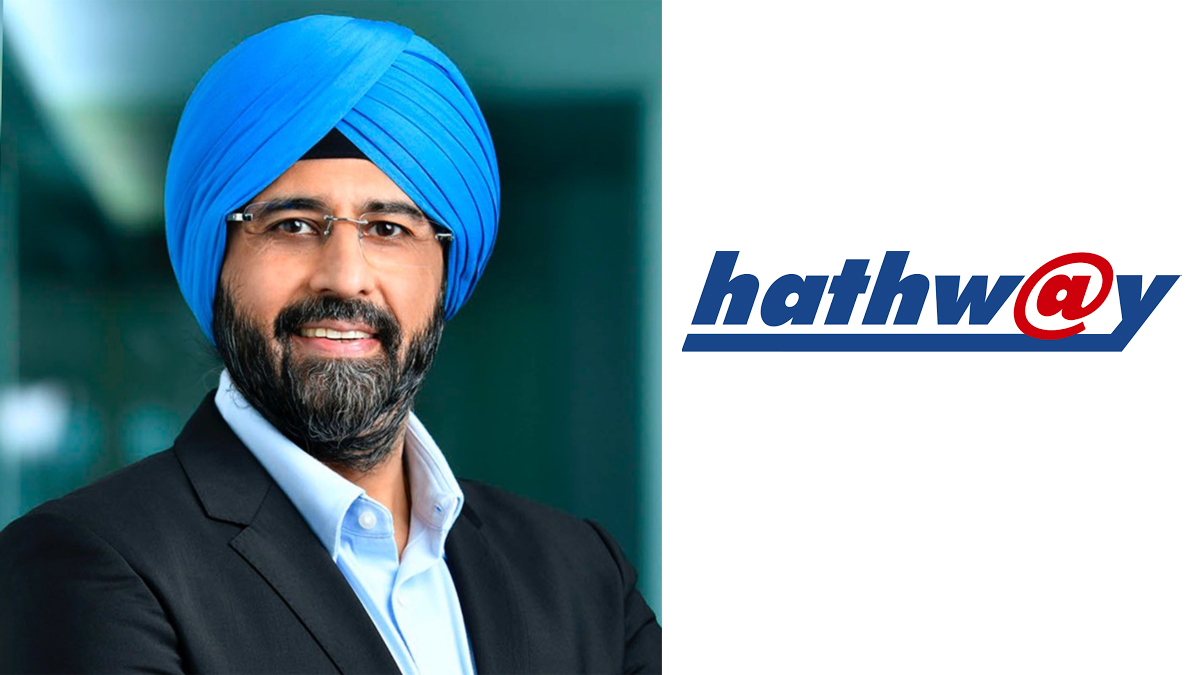
MUMBAI: Hathway Cable and Datacom has tapped industry veteran Gurjeev Singh Kapoor as chief executive officer, marking a leadership pivot at a time when India’s cable television business is under mounting strain.
Kapoor will take over from Tavinderjit Singh Panesar, who is set to retire in August after a long innings with the company. Panesar, chief executive since 2023, has held multiple leadership roles at Hathway, including his latest stint beginning in 2022.
Kapoor brings more than three decades of experience in media and entertainment. He most recently led distribution at The Walt Disney Company’s Star India business, now part of JioStar. His career spans television distribution and affiliate partnerships, with stints at Sony Pictures Networks India, Discovery Communications and Zee Entertainment.

Panesar, with over three decades in the industry, has worked across strategic planning, distribution and business development in media, broadcasting and manufacturing. His past associations include ESPN Star Sports, Star India, Apollo Tyres and JK Industries.
The transition lands as the cable sector grapples with structural disruption. Traditional operators are losing ground to streaming platforms, while telecom and broadband players tighten the squeeze with bundled offerings.
An EY report estimates India’s pay-TV base could shrink by a further 30 to 40 million households by 2030, taking the total down to 71 to 81 million. The slide follows a loss of nearly 40 million homes between 2018 and 2024, a contraction that has already wiped out more than 37,000 jobs in the local cable operator ecosystem.
Hathway’s numbers reflect the strain. The company reported a consolidated net profit of Rs 93 crore for FY25, down from Rs 99 crore a year earlier. Revenue inched up to Rs 2,040 crore from Rs 1,981 crore. As of December 2025, it had about 4.7 million cable TV subscribers and roughly 1.02 million broadband users.
Kapoor steps in with a familiar brief but a shrinking playbook. In a market where viewers are cutting cords faster than companies can reinvent them, the new chief executive inherits a business fighting to stay plugged in.