Gaming
India’s Esports contingent concludes historic debut campaign at Asian Games 2022

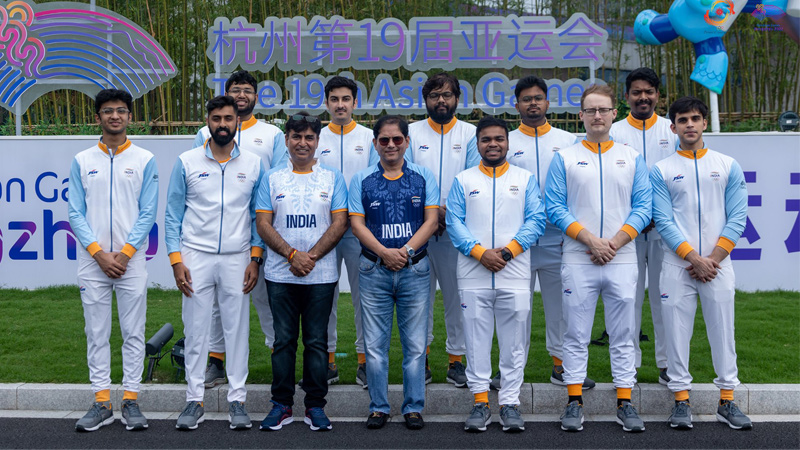
Mumbai: India’s 15-member Esports contingent wrapped up its remarkable journey at the ongoing Asian Games 2022 as the nation’s DOTA 2 team exited the competition at the China Hangzhou Esports Centre on Friday.
The DOTA 2 squad led by skipper Darshan Bata (A35), and comprising Krish Gupta (Krish-), Abhishek Yadav (Abhi-), Ketan Goyal (Evil-Ash), and Shubham Goli (Madness) endured a 0-1 defeat against Kyrgyzstan in their opening group game before going down 0-1 against the Philippines in the second group stage game to bow out of the competition.
In what was Esports’ debut as an official medal sport at the prestigious tournament, India had participated in four of the seven total titles namely: DOTA 2, League of Legends, EA Sports FC Online, and Street Fighter V: Champion Edition.

“We are proud of our Esports athletes’ resolute efforts and gritty performances at the Asian Games 2022. Each and every athlete from the contingent is an inspiration for India’s budding Esports community that wants to represent their country in Esports. This tournament has provided an invaluable experience and motivation for our Esports athletes to build upon and enhance their gameplay for the future,” said Esports Federation of India director and Asian Esports Federation (AESF) VP Lokesh Suji.
India’s prolific League of Legends team captained by Akshaj Shenoy (Kai), and comprising Samarth Arvind Trivedi (CrankO), Mihir Ranjan (Lotus), Sanindhya Malik (Deadcorp), Aakash Shandilya (Infi), Aditya Selvaraj (Krow) finished fifth at 19th Asian Games after suffering a hard-fought 0-2 defeat against Vietnam in the quarter finals.
The country’s star EA Sports FC Online athlete, Charanjot Singh, secured the ninth place out of a total pool of 36 leading athletes from the continent in this competition. The 20-year-old began his campaign with a 0:2 defeat to China’s Liu Jiacheng in the Round of 32 but bounced back strongly with three consecutive wins against Aristorenas Jorrel of Philippines, Alrowaihi RKM of Bahrain, and Yessentayev Olzhas of Kazakhstan in the Losers Bracket Round 1, 2, and 3 respectively.
However, his campaign came to an end after enduring another 0-2 defeat against Liu Jiacheng of China in the Losers Bracket Round 4. His compatriot Karman Singh exited the competition after going down by 1-2 against Aldhafiri Meshari of Kuwait in the Losers Bracket Round 2.
“Despite the competition being fierce, our League of Legends team secured a remarkable fifth-place finish, while Charanjot Singh achieved a commendable ninth place among the continent’s top EA Sports FC Online athletes. We are now eagerly anticipating the Asian Games 2026, where Esports will once again be an official medal sport, and our full-strength Indian contingent will give their all in pursuit of glory,” added Lokesh Suji.
In Street Fighter V: Champion Edition, the talented Ayan Biswas clinched a Top 16 place for India. He began his campaign on a winning note against Nguyen Khanh Hung Chau of Vietnam from the Round of 32 suffering a defeat against Alrayfal Abdulrahman Salem A of Saudi Arabia in the Winners Bracket Round 1. He then beat Vietnam’s Nguyen again by 2-0 in the Losers Bracket Round 2 but fell short against Yeh Man Ho of Hong Kong in the Losers Bracket Round 3.
Ayan’s teammate, Mayank Prajapati began his tournament against Rajikhan Talal Fuad T of Saudi Arabia and fought valiantly in a fiercely contested 1-2 defeat. He then endured another loss against Al-Mannai Abdulla of Qatar by 0-2 in the Losers Bracket Round 1 and exited the tournament.
Having been featured as a demonstration event in 2018, Esports made its full-fledged debut as an official medal sport at the Asian Games 2022 where a total of 476 athletes from 30 different countries competed for gold medals in seven different titles.



Gaming
Dream Sports sees 100 plus exits after gaming ban forces overhaul
Company splits into eight units as real money gaming law hits revenue.

MUMBAI: For a company built on fantasy leagues, reality has suddenly rewritten the rulebook. More than 100 employees have exited Dream Sports, the parent of Dream11, after the company reorganised its operations following India’s ban on real money online gaming. The shake up came after the Promotion and Regulation of Online Gaming Act, 2025 came into force in August 2025, prohibiting games where users deposit money expecting winnings. The regulation struck at the heart of the fantasy gaming industry and dramatically affected Dream Sports’ core business, wiping out about 95 percent of its revenue and all of its profits.
In response, the Mumbai based company shifted into what chief executive officer Harsh Jain described as “startup mode”, splitting its operations into eight independent business units in December.
Around 700 employees were reassigned across these newly formed ventures based on their experience and interests. However, roughly 15 percent opted to leave the company.
A spokesperson for Dream Sports said many of those who exited were experienced professionals accustomed to running scaled businesses rather than early stage ventures.
“Since some of these employees were experienced with running high scale businesses and not startups, around 15 percent chose to leave and join other scaled companies or start ventures of their own,” the spokesperson said.
Despite the departures, the company noted that the attrition rate is only slightly higher than its earlier level of around 10 percent before the ban. Dream Sports now has close to 950 employees and is not currently hiring, choosing instead to focus on stabilising its existing workforce.
The restructuring has transformed Dream Sports from a fantasy gaming company into a broader sports entertainment platform. The eight units now operate independently, each focusing on different segments of the sports and technology ecosystem.
These include Dream11, sports streaming platform Fancode, sports travel service DreamSetGo, mobile game Dream Cricket and artificial intelligence initiative Dream Sports AI, which includes sports analytics platform Dream Play.
Other ventures include fintech product Dream Money, open source initiative Dream Horizon and the philanthropic arm Dream Sports Foundation.
As part of cost saving efforts, Dream Sports also relocated its headquarters from Bandra Kurla Complex to Worli earlier this year. The new office, called Dream Sports Stadium, brings teams from its various brands together under one roof to improve collaboration and operational efficiency.
Jain had earlier said the company removed bonus lock in timelines for employees hired in recent years, allowing those who wished to leave to exit with pro rata payouts.
“We want people who are fully into the startup mode and willing to work for it, and we will share that reward if it comes,” he said.
Founded in 2008 by Harsh Jain and Bhavit Sheth, Dream Sports was last valued at 8 billion dollars after raising 840 million dollars in 2021 from investors including Falcon Edge Capital, DST Global, D1 Capital Partners, RedBird Capital Partners, Tiger Global Management, TPG and Footpath Ventures.
The new gaming law has forced several companies in the fantasy gaming sector to either shut down or pivot their business models, signalling a significant reset for one of India’s fastest growing digital entertainment industries.