Cable TV
“Further price freeze will stall growth” – Jayaraman

It has been the worst period of inactivity in the cable TV industry. Since the price freeze on subscription rates imposed by the Telecom Regulatory Authority of India (Trai), there has been very little fresh capital infusion into the sector.
Already, multi system operators (MSOs) have spent an estimated Rs 8 billion to make their networks conditional access system (CAS) ready. This followed the government‘s decision to mandate CAS in the four metros of Mumbai, Delhi, Kolkata and Chennai.
Subsequent retractions on the implementation of CAS have hit cable networks hard. Only Chennai was made a CAS market, and even there consumers have shown poor response. The government asked the Trai to look into the complex issue of CAS and come out with recommendations. The first thing the broadcast and cable TV regulator did was to freeze rates with effect from 26 December, 2003.

So what has been the focus of MSOs? A look at how a few MSOs have managed their businesses in a year where CAS remained in limbo and subscription prices stayed frozen. And the plans they have set out for the near term.
Hathway Cable & Datacom
The sense in Hathway Cable & Datacom is growing that it needs to do something to beat the status quo.
First, it wants to launch its digital cable TV service in Mumbai, Delhi and Bangalore. There are 185,000 digital set-top boxes (STBs) lying idle. The plan is to push them for sale by October-end.
“We can‘t afford to wait for mandated CAS,” says Hathway Cable & Datacom chief executive officer K Jayaraman.
Having invested Rs 1 billion for CAS, Hathway has to turn things round fast. Some of the rival MSOs have already put their STBs for consumers to buy. The lure: additional channels and a whole new digital experience.
Hathway‘s offer is 140 channels. For the STBs, consumers will have to pay Rs 3,150 (plus local taxes). There is no rental scheme. “We feel eight per cent of our total cable TV subscribers will switch over to the digital service as we have a strong presence in upmarket areas,” says Jayaraman.
That may be a tall hope. Consumers aren‘t particularly enthusiastic to buy. But it is a step Hathway has to take to be in line with competition and secure its network by putting up its STBs in consumer homes first. An additional investment of Rs 70 million is something that Hathway can well afford.
Second, Hathway needs the price freeze out. Of course, the outgo towards pay TV broadcasters this year has been almost flat. This has helped the MSO focus on other related business areas like Internet over cable. But, as Jayaraman says, the other costs are due for renewal. “The price freeze provided us short term relief, particularly when we had no implementation of CAS. But now it is beginning to hurt.”
What Hathway has been trying to do during this nine-month period is to improve bill collections, minimise overheads and focus on Internet and local cable channels.
Recovery of money from the franchise operators was difficult, particularly in the absence of unity among the MSOs and the practice of poaching from rival networks. But the promise of mandated CAS – and the mess that followed it – forced MSOs to sit together on a common cause. They broadly agreed not to get into each other‘s territories. This helped them improve collections from franchise operators.
“Our recovery from current billings has gone up, from 60-70 per cent to 80 per cent,” says Jayaraman. Hathway charges a monthly fee of Rs 150 a month per subscriber from its franchisees.
The recovery rate was higher in cities like Mumbai than in Delhi and Bangalore. With a high percentage of independent cable operators, poaching was still a practice in Delhi and Bangalore. In contrast, Mumbai is largely an MSO market. Admits Jayaraman, “There was some fight for market share in certain territories. But among the MSOs, there was very little attempt to poach.”
Hathway also spent its energy in growing revenue streams outside the traditional income from cable transmission. Cable over Internet was a big area of focus and Hathway was the most aggressive among all the MSOs to push this segment. During the year, Hathway lowered cost of cable modems (Rs 2,999, from Rs 3,999), launched more competitive entry packages (Rs 300 a month, down from Rs 650), and introduced high speed packages (256 kbps, from 64 kbps). Also on offer was broadband Internet service through ethernet to go more mass. Hathway could, thus, start offering its Internet services in areas where it was taking time to build the cable network for two-way capability.
There was a thrust to increase revenues from CCC (a cable movie channel), ITV (dial-in music channel) and local cable channels across different locations. To increase penetration, CCC was made available in non-Hathway cable networks as well.
“We expect a 30 per cent revenue growth this year from our Internet business and 10-12 per cent from local channels,” says Jayaraman.
On the expenditure side, Hathway has tried to reduce overhead costs. “Because of our CAS investment and a price freeze on subscription rates, we have completely curtailed our capital expenditure. There is no point in expanding the network under the current scenario,” says Jayaraman.
But that can‘t be the growth strategy, even though the payout cost to broadcasters will see a marginal rise this year (In 2003-04, it rose 33 per cent to Rs 1.07 billion). “Though content costs are not up, we have our overhead costs. This way, there can be no growth in the industry. It is not an ideal situation to be in for the medium and long term,” says Jayaraman.
The fact is that Hathway had ambitious plans in a CAS regime and even had assigned Fitch to rate a proposed Rs 50 million commercial paper (short term debt). Having loose agreements with local cable operators and investment exposures to some loss-making subsidiaries, CAS, in fact, was expected to improve Hathway‘s liquidity position and increase its revenues. The MSO had plans to raise Rs 250 million if expansion was necessary in a CAS scenario.
Such fund-raising plans are not necessary now. “CAS would have at least brought transparency. A new business model would have come,” says Jayaraman. Until that happens, Hathway will try to push its digital STBs, focus on broadband and cable channel businesses, and hope for a lift in the price freeze on subscription rates.





Cable TV
Hathway Cable appoints Gurjeev Singh Kapoor as CEO
Leadership change comes as cable TV faces shrinking subscriber base and modest earnings pressure
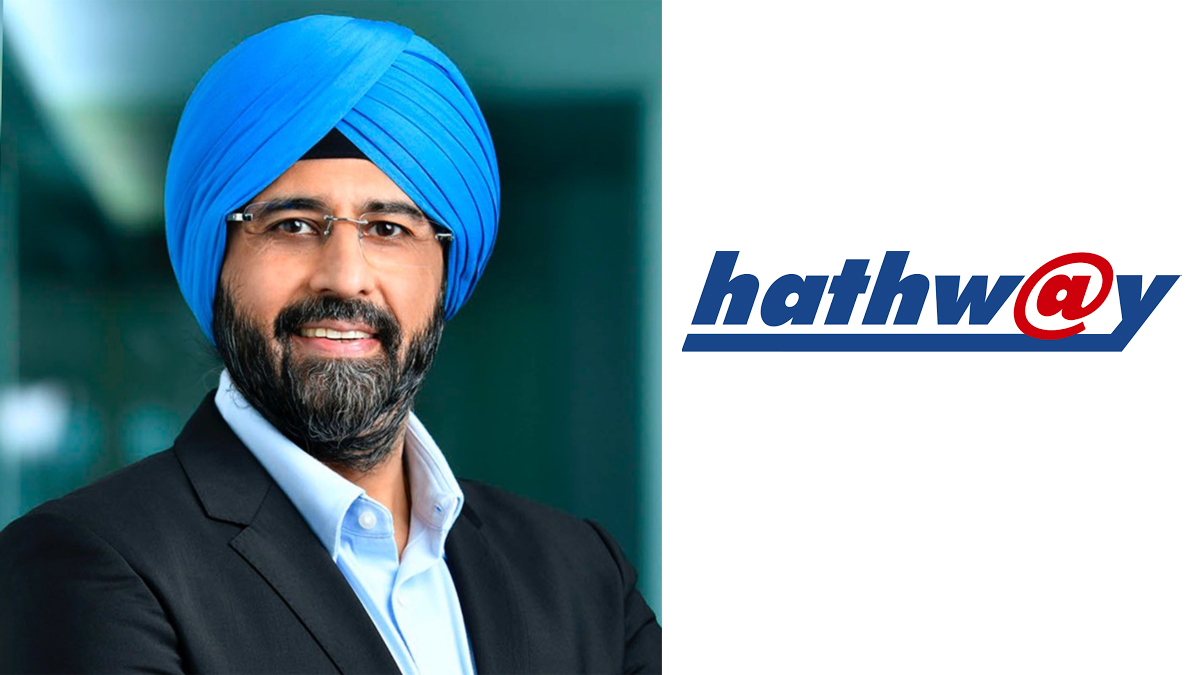
MUMBAI: Hathway Cable and Datacom has tapped industry veteran Gurjeev Singh Kapoor as chief executive officer, marking a leadership pivot at a time when India’s cable television business is under mounting strain.
Kapoor will take over from Tavinderjit Singh Panesar, who is set to retire in August after a long innings with the company. Panesar, chief executive since 2023, has held multiple leadership roles at Hathway, including his latest stint beginning in 2022.
Kapoor brings more than three decades of experience in media and entertainment. He most recently led distribution at The Walt Disney Company’s Star India business, now part of JioStar. His career spans television distribution and affiliate partnerships, with stints at Sony Pictures Networks India, Discovery Communications and Zee Entertainment.
Panesar, with over three decades in the industry, has worked across strategic planning, distribution and business development in media, broadcasting and manufacturing. His past associations include ESPN Star Sports, Star India, Apollo Tyres and JK Industries.
The transition lands as the cable sector grapples with structural disruption. Traditional operators are losing ground to streaming platforms, while telecom and broadband players tighten the squeeze with bundled offerings.
An EY report estimates India’s pay-TV base could shrink by a further 30 to 40 million households by 2030, taking the total down to 71 to 81 million. The slide follows a loss of nearly 40 million homes between 2018 and 2024, a contraction that has already wiped out more than 37,000 jobs in the local cable operator ecosystem.
Hathway’s numbers reflect the strain. The company reported a consolidated net profit of Rs 93 crore for FY25, down from Rs 99 crore a year earlier. Revenue inched up to Rs 2,040 crore from Rs 1,981 crore. As of December 2025, it had about 4.7 million cable TV subscribers and roughly 1.02 million broadband users.
Kapoor steps in with a familiar brief but a shrinking playbook. In a market where viewers are cutting cords faster than companies can reinvent them, the new chief executive inherits a business fighting to stay plugged in.