MAM
Brand building and innovation paramount amidst price wars

MUMBAI: For a couple of years now, consumers have been subjected to the ongoing price war between the detergent and shampoo brands of Hindustan Lever Limited (HLL) and Proctor & Gamble (P&G). Keeping these rigorous price wars in mind, the first day of the India Brand Summit held in Mumbai on 30 October saw a session on ‘Role of brands in the wake of price wars.’
The session was chaired by Reliance Infocomm head marketing and branding Sanjay Behl and the panelists included Monginis Foods chairman Zoher Khorakiwala, UDV India Ltd director marketing Santosh Kanekar and The Times of India Group executive president Bhaskar Das.

Behl kicked off the session by naming various companies like HLL, P&G and Reliance, which had cut costs of their products and hence increased competition in the market. “HLL and P&G indulged in bloodied price wars of their products a couple of years back. Phone calls from Reliance were cheaper than post cards. And factor this; Philips is going to roll out a mobile handset, which will cost less than Rs 1000. The company has set a 2007 launch target but my guess is that it will be rolled out in the next six months,” he said.
Posing a question as to whether price was the only real differentiator left for brands in the market and in the wake of this how do brands manage themselves; Behl opened the floor to the panelists.
Khorakiwala set the mood of the audience by saying that the world’s oldest profession was prostitution wherein women provided the same services but the prices they charged were different based on the quality of their services. “That’s how branding was born,” he said.
Laying down the ground realities of what initiated the brand wars, Khorakiwala said, “Brand wars were created by owners, market forces, customer and technology. Generally it is a new entrant that creates these price wars to generate trails and thus poses a challenge to the leaders in the space. Another reason would be to expand the category and also to prevent a new entrant from succeeding.”
He went on to say that in order for a product to survive in the wake of the price wars, brand building was paramount. “The higher the brand equity, the lower is the resistance to price. The brand has to create a value positioning statement and there has to be product differentiation. Your product has to stand for ‘something’ and not for ‘everything’ in the consumer’s mind space. Finally, price as a sole positioning platform does not create a competitive advantage in the long run,” he said.
DAs, on his behalf said that the concept of price wars was highly over estimated. Citing the example of Jumbo Vada Pav, which copied the McDonald model albeit a much cheaper one, DAs said, “There is a huge process that is involved in low cost operations. One has to keep the value proposition of the brand in mind and the same time figure out how to handle low costs. With all the choices that are today available in the market, the challenge for brands is to be strategically different and know your target audience. One has to apply fluid knowledge and not crystallised knowledge to stay ahead in the game because while price is transparent, value is opaque.”
Bhel closed the session by saying that the changing paradigm of innovation was what was going to be the trigger for survival in the competitive market.

MAM
BLR Airport Launches ‘Connections’ Service to Ease Transit Travel
New initiative targets smoother transfers as Bengaluru hub traffic rises 30 per cent.
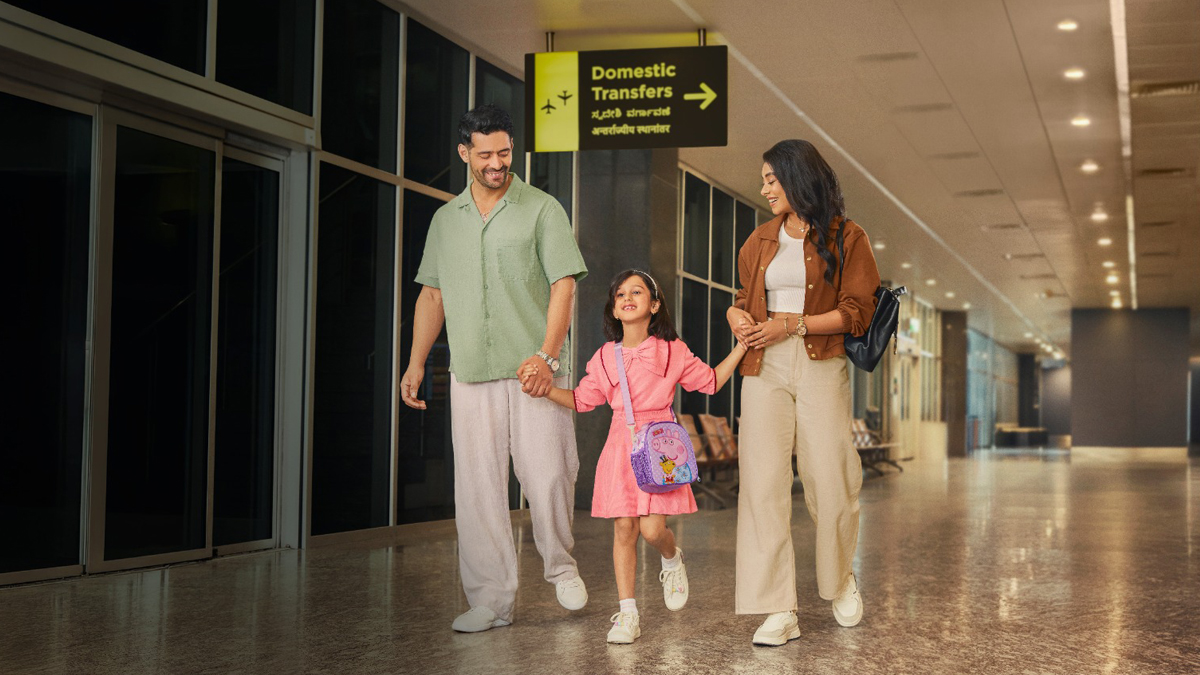
MUMBAI: Missed connections may be a traveller’s nightmare but Bengaluru is trying to make them a thing of the past. Kempegowda International Airport Bengaluru (BLR Airport) has rolled out ‘Connections by BLR’, a new transfer programme designed to take the friction out of connecting journeys. Built around three pillars ease, efficiency and experience,the initiative aims to simplify what is often the most stressful leg of air travel.
The move comes as transfer traffic at BLR Airport climbs sharply, up more than 30 per cent year-on-year. Transfers currently account for around 15 per cent of total passenger traffic and are projected to touch 20 per cent by 2026, signalling a clear shift in how the airport is positioning itself within airline networks.
At its core, the programme focuses on making navigation intuitive and downtime more comfortable. Dedicated transfer desks have been set up across terminals, supported by colour-coded wayfinding blue and yellow signage designed for quick recognition. Inter-terminal movement is being streamlined through complimentary shuttle services with predictable wait times, while designated transfer zones aim to reduce passenger confusion.
Beyond logistics, the airport is leaning into experience. Travellers in transit now have access to a wider choice of lounges, curated retail and food and beverage options, as well as sleeping pods for short stays. For longer layovers, transit hotels in both Terminal 1 and Terminal 2 offer boutique in-terminal accommodation, an increasingly sought-after feature as global travel patterns evolve.
The timing is strategic. BLR Airport now connects to 114 passenger destinations 80 domestic and 34 international with key routes spanning Delhi, Mumbai, Kolkata, Hyderabad and Pune domestically, and Singapore, London Heathrow, Dubai, Abu Dhabi and Kuala Lumpur internationally. Recent additions such as Hindon, Bidar and Silchar within India, alongside Dammam, Hanoi and Riyadh overseas, are further expanding its reach.
Infrastructure is also catching up with ambition. Developments including the West Cross Taxiway, Terminal 1 refurbishment and Terminal 2 expansion are laying the groundwork for higher capacity and smoother operations critical for any airport aiming to become a serious transfer hub.
Bangalore International Airport Limited chief operating officer Girish Nair framed the initiative as both a response to demand and a forward-looking play. He pointed to the growing depth of the airport’s network and the opportunity to build a more reliable transfer ecosystem that benefits both passengers and airline partners.
In an era where travel is as much about transitions as destinations, BLR Airport is betting that a seamless connection might just be the journey’s most important upgrade.







