Kids
Educational TV content for US children not up to the mark

MUMBAI: A new study by US organisation Children Now reveals substantial deficiencies in children’s educational television programming and raises serious doubts about broadcasters’ commitments to the nation’s children.
The study called Educationally/Insufficient? An Analysis of the Availability &and Educational Quality of Children’s E/I Programming evaluated the quality of programmes claimed as educational/informational (E/I) by commercial stations.
It found that only one of every eight E/I shows (13 per cent) is rated as highly educational. In contrast, almost twice as many, nearly one of every four (23 per cent) were classified in the lowest category of minimally educational. Most E/I programmes (63 per cent) were judged to be moderately educational.
Media researchers Dr. Barbara J. Wilson (University of Illinois), Dr. Dale Kunkel (University of Arizona) and Kristin L. Drogos (University of Illinois) analysed 120 episodes across 40 programme titles, evaluating each show on a range of educational criteria that are associated with children‘s learning from television. Their findings indicate that most programmes designated as E/I offer only limited educational value for child viewers.
The study notes that when only one in eight E/I episodes is highly educational and nearly twice as many are deficient in educational merits; when few broadcasters offer more than the bare minimum of programming and confine their entire E/I schedule to one or two days of the week; when more than one-quarter of E/I shows model harmful violent or socially aggressive behavior; and when the vast majority of programs contain no basic academic or health-related lesson, it is difficult to see how broadcasters’ efforts are sufficiently serving the educational needs of the nation’s children.
Children Now’s Children and the Media programme Christy Glaubke says, “This evidence suggests that the nation‘s children are being short-changed by broadcasters. This is clearly a missed opportunity to help support the educational development of the nation‘s children.”
Commercial television broadcasters are required by law to air children‘s E/I programming as part of their public service obligations in return for the free use of publicly-owned airwaves. The Federal Communications Commission (FCC) enforces this requirement and has specified that each station should air a minimum of three hours per week of children‘s educational programming.
The new study reveals that the large majority of stations (59 per cent) deliver only the minimum required amount, with just 3 per cent of stations nationally offering more than four hours per week. Furthermore, 75 per cent of stations schedule E/I programming exclusively on weekends, despite the fact that children watch an average of three hours of television per day every day of the week.
Previous studies in the 1990s found that between 20 per cent and 33 per cent of E/I programmes were rated as highly educational. Thus, the new data suggest that educational quality is at the lowest point yet measured for E/I shows aired on commercial channels.
In contrast, the educational programming delivered by US pubcaster PBS was rated significantly higher (receiving an average quality rating of 9.1 on a 12-point scale) than were E/I shows on commercial stations (which received a 7.9 average score).
Another important difference is that PBS programs tended to emphasize cognitive-intellectual lessons in their educational fare (55 per cent of programs), whereas commercial channels relied largely on social-emotional lessons (67 per cent of programs), such as sharing or getting along with others, as their educational substance.

Kids
Mukta Arts and Green Gold ink MOU to animate iconic film IPs
Kalicharan, Karz, Hero, Karma, Ram Lakhan to spawn animated shows plus features.
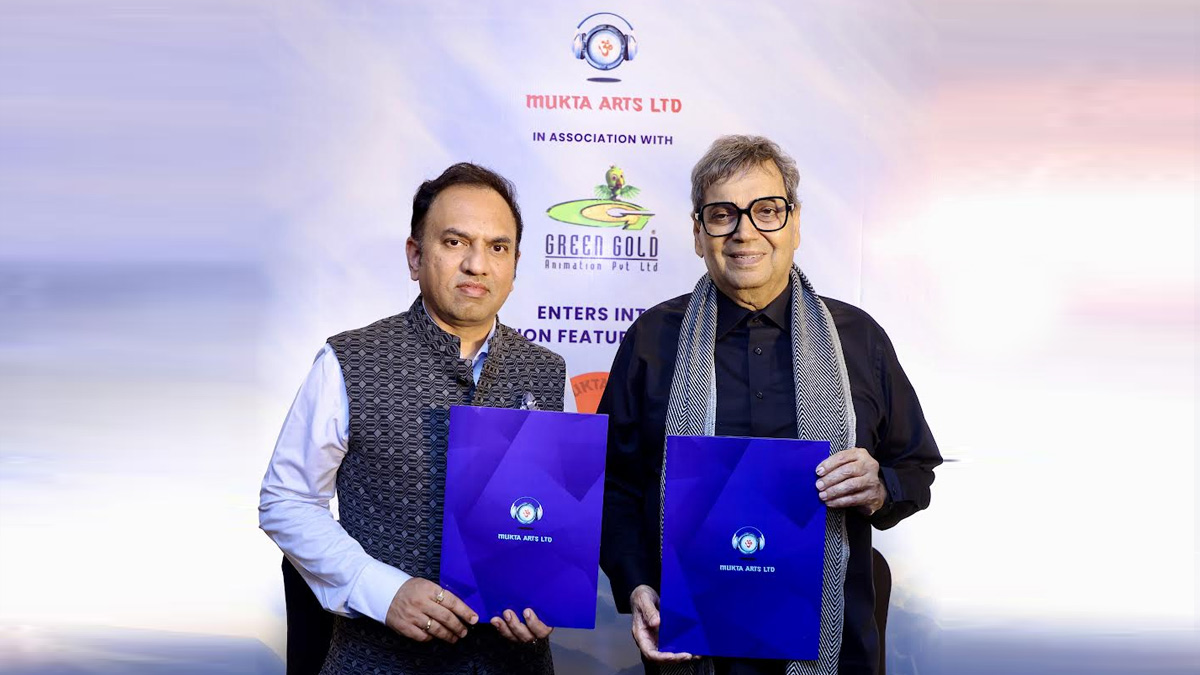
MUMBAI: When classic hindi movie meets animation, the result is a fresh reel of nostalgia with a cartoon twist. Mukta Arts Ltd. and Green Gold Animation have signed a Memorandum of Understanding (MOU) to collaborate on animated shows and feature films drawn from Mukta Arts’ four-decade treasure trove of iconic IPs. The partnership taps Mukta’s SGM Animation Studio launched in 2025 as its dedicated animation and games arm and Green Gold’s proven track record in building scalable, homegrown franchises. Creative teams from both sides have already kicked off discussions, with the first project currently in development.
The slate will draw inspiration from landmark Mukta films including Kalicharan, Karz, Hero, Karma, Ram Lakhan, Khalnayak, Saudagar and Iqbal, plus character-led spin-offs from those universes. The aim is to reimagine these stories for today’s young, global audiences while preserving their emotional core.
Green Gold Animation (home of Chhota Bheem) founder and CEO Rajiv Chilaka said, “This partnership with SGM Studios allows us to apply our experience in building long-lasting animation IPs to a truly iconic film catalogue. Together, we aim to create animated worlds that are rooted in these legendary stories, yet designed to connect with today’s young, global audiences.”

Mukta Arts Ltd. filmmaker and founder Subhash Ghai added, “Mukta Arts has always believed in creating stories with lasting emotional value. Through animation, we are extending our IP into a new medium for the next generation.”
In an industry where timeless tales never go out of fashion, this collaboration promises to bring beloved characters back to life with a modern, animated glow proving that some stories are too good to stay in live-action. Stay tuned for the first animated frame to drop.






