Hindi
Multiplexes turn face away from Yeh Jo Mohabbat Hai
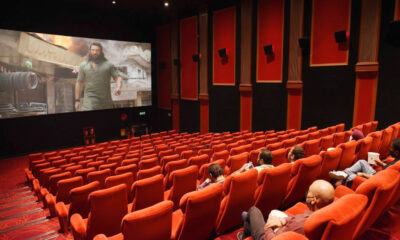
Mumbai: The producers of Yeh Jo Mohabbat Hai have been left in the lurch with the movie failing to get enough screens for exhibition. It could only manage a few multiplexes but only for a few shows, it is unlike what producer Ashim Samanta had envisaged about.
Grouses Samanta, “It seems the multiplex cartel has decided not to release non-star cast films (the film stars Aditya Samanta and Nazia Hussain) because they say that they don‘t get the numbers.”
He adds, “However, they are kind enough to give us two shows; one in the morning 9 am show and the other at 12.15 am. At least we are better off; Prateek Chakraborty‘s From Sydney With Love could not get even one screen. Hence, they have postponed the film‘s release to 24 August. However, I fail to understand the logic as to why Krishna Aur Kans has as many as 300 multiplex screens at its disposal.”
Samanta relates that the condition remains similar outside Mumbai too. “We haven‘t got a single screen in Hyderabad, Nagpur, Chandigarh and Jallandhar. In Baroda, we have been allotted one show. However, my film has got as many as 50 to 60 screens in Assam.”
When inquired about the matter with Shyam Shroff of Shringar Films, the distributor of the film, he said, “They should thank their stars that they got some shows; see what happened to the Prateek Chakraborty film? With films like Bol Bachchan, Cocktail and The Dark Knight Rises doing pretty well, exhibitors are just not interested to take up non-star cast films for release.”
Averred Cinemax DGM Girish Wankhede, “We don‘t get the required numbers for a non-star film and with several a-listed films doing quite well, we have allotted them only two shows that we could afford.”

Hindi
Kridhan Infra enters film production with AI-led feature film
Infra firm debuts AI-powered film marking RSS centenary
MUMBAI: Kridhan Infra Limited is swapping hard hats for headsets. The infrastructure company has announced its entry into film production and media technology through its subsidiary, Kridhan Mediatech Private Limited, with the nationwide theatrical release of Shatak: Sangh Ke 100 Varsh, an AI-led feature film.
With Shatak, the company is not just stepping into cinema but staking a claim in what it describes as one of the world’s early full-length AI-driven feature films. Artificial Intelligence has been embedded across the creative and production process, from script visualisation and environment creation to modelling and production design.
The film commemorates 100 years of the Rashtriya Swayamsevak Sangh, tracing defining moments, personalities and historical phases that shaped its journey. By combining archival storytelling with algorithm-powered creativity, the project attempts to blend heritage with high technology.
For Kridhan Mediatech, this is only the opening scene. The subsidiary’s broader ambition spans AI, CGI, virtual production systems and scalable content models for both theatres and digital platforms. The move signals a strategic diversification for Kridhan Infra, traditionally rooted in engineering and construction.
The timing aligns with India’s growing push to become a global AI powerhouse. At the 2026 AI Impact Summit, prime minister Narendra Modi urged innovators to design in India and deliver to the world. Kridhan Mediatech’s initiative positions itself squarely within that narrative, aiming to export technology-enabled storytelling beyond domestic audiences.
India’s media and entertainment industry, valued at over Rs 2.5 lakh crore, alongside a rapidly expanding AI economy projected to cross Rs 1.4 lakh crore in the coming years, offers fertile ground at the intersection of cinema and code.
“With Shatak, we proudly present one of the world’s first AI-led full-length feature films while marking our strategic entry into film production and media technology through our subsidiary,” the company said in a statement. “Our vision is to combine India’s rich narrative heritage with forward-looking innovation. This is just the beginning of building globally competitive, technology-enabled cinematic experiences.”
From infrastructure to imagination, Kridhan’s latest venture suggests that in today’s India, even storytelling can be engineered.