Hindi
FTBHJ to release on Spuul.com on 13 Nov


MUMBAI: Bollywood film ‘Future Toh Bright Hai Ji’, which is currently running in theatres, will release online on Spuul.com, ten days after the film’s theatrical release on 2 November.
Starting 13 November, movie lovers worldwide, including India, can instantly watch ‘Future Toh Bright Hai Ji’ (FTBHJ) anytime, anywhere on a wide variety of devices by signing up for an account on Spuul.com or downloading Spuul’s free app for the iPhone, iPad and iPod Touch.
Spuul.com, which already has over a million views, will allow movie buffs worldwide and in India to watch the film on the web as well as on their mobile devices.

Commenting on the film’s unique online release, V One Entertainment Director Ashok Jain said, “When we distribute films, our key endeavour is to maximize their reach. I am delighted that this online release on Spuul will not only take FTBHJ to a far larger audience worldwide, but will also revolutionize film distribution. I am very happy that V One Entertainment is ushering in something as significant as this.”
Spuul South Asia head Prakash Ramchandani said, “We are confident that thanks to the all-important factors of instant access, convenience, top quality streaming and an excellent overall viewing experience at home or on the go, FTBHJ’s online release on Spuul will ensure that many more movie buffs, worldwide, enjoy the movie. It will also significantly energize the film industry by putting the spotlight on the growing audience that watches Indian movies online.”
FTBHJ is the story of a young small town couple trying to make it big in Mumbai. After struggling for long, the couple visits an astrologer and is led to believe that their life will change for the better in seven days. Watch FTBHJ to find out if things turn around for the better.
The film has been directed by Sanjay Amar, with music by Mohinderjeet Singh and songs sung by Sunidhi Chauhan, Shaan and Neeraj Shridhar. The star cast includes Aamir Bashir, Satish Kaushik, Sonal Sehgal, Neelima Azim, Delnaz Paul and Vipin Sharma.



Hindi
Remembering Gyan Sahay, the lens behind film, television and advertising
From a puppet rabbit selling poppadums to Hindi cinema, he framed it all.
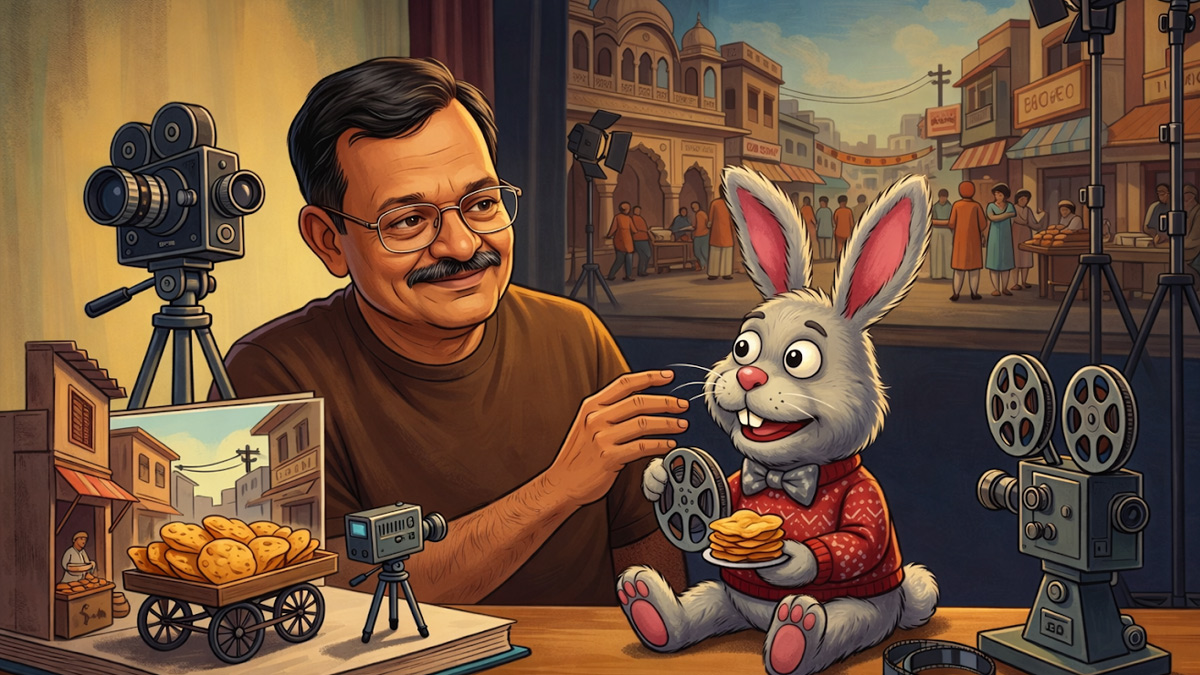
MUMBAI: There are careers, and then there are canvases. Gyan Sahay, the veteran cinematographer, director, and producer who passed away on 10 March 2026 in Mumbai, had one of the latter. Over several decades in the Indian film and television industry, he turned lenses, lights, and the occasional puppet rabbit into something approaching art.
A graduate of the Film and Television Institute of India (FTII) in Pune, Sahay built his reputation as a director of photography across a career that stretched from the early 1970s all the way to the digital age. He was the kind of craftsman who understood that a well-composed shot is not merely a technical achievement but a quiet act of storytelling.
For most Indians of a certain age, however, Sahay will forever be the man behind the rabbit. His direction of the iconic long-running television commercial for Lijjat Papad, featuring its now-legendary puppet bunny, gave the country one of its most cheerfully persistent advertising images. It was the sort of work that sneaks into the national subconscious and takes up permanent residence.
His big-screen credits as cinematographer include Anokhi Pehchan (1972), Pagli (1974), Pas de Deux (1981), and Hum Farishte Nahin (1988). In 1999, he stepped behind a different kind of camera altogether, making his directorial debut with Sar Ankhon Par, a drama that featured Vikas Bhalla and Shruti Ulfat, with a cameo by Shah Rukh Khan for good measure.
On television, Sahay was particularly prized for his command of multi-camera production setups, a skill that made him a go-to technician for large-scale shows and reality programmes. In an industry that has never been especially patient with complexity, he was the calm hand on the rig.
In later life, Sahay turned teacher. He participated regularly in masterclasses and Digi-Talks, often hosted by organisations such as Bharatiya Chitra Sadhna, sharing hard-won wisdom on cinematography, the comedy of timing in a shot, and the sweeping changes brought by the shift from celluloid to digital. He was also said to have been involved in a project concerning a biographical film on Infosys co-founder N.R. Narayana Murthy.
Tributes from the film industry poured in following the news of his passing, with colleagues remembering him as a senior cameraman who served as a rare bridge between two entirely different eras of Indian cinema. That is, perhaps, the finest thing one can say of any craftsman: he kept up, and he brought others along with him.







