Digital
Wibmo and Gupshup join forces for innovative transaction notifications via WhatsApp

Mumbai: Wibmo, a PayU company and a leading authority in payment security, fraud prevention, risk management solutions, and digital payments, proudly announces a strategic collaboration with Gupshup, the leading Conversation Cloud platform. As part of this alliance, Wibmo, a PayU company, leverages Gupshup’s conversational Cloud platform to provide international issuers with the capability to deliver transaction notifications via WhatsApp. This proves invaluable in areas where network issues may cause delays in SMS OTP delivery. Additionally, Indian issuers stand to benefit as they can seamlessly send OTPs via WhatsApp to international customers, presenting a cost-effective alternative to SMS, particularly for multiple transactions within a 24-hour timeframe without compromising security.
Key Highlights of the Partnership:
Reduced Dependency on Regulatory SMS Compliances: Businesses can diminish their reliance on varied regulatory SMS compliances across different countries related to telecom, mitigating the impact on customers caused by time-to-time regulatory changes.

Cost Reduction for Repeated Transactions: Issuers can significantly cut costs for repeated transactions within a day, enhancing operational efficiency and financial savings.
Improved OTP Delivery Success Rate: The collaboration ensures an enhanced OTP delivery success rate compared to traditional SMS OTP, boosting overall transaction security and reducing business drop.
Benefits of the WhatsApp Channel:
Higher Trust Factor: WhatsApp’s verification process guarantees the credibility of messages, providing recipients with a higher level of trust compared to traditional SMS.
End-to-End Encryption: WhatsApp OTP messages boast end-to-end encryption, ensuring that only the intended recipient can access the message, eliminating any risk of interception.
Better Delivery Success Rates: WhatsApp’s near 100% delivery rates, even in poor cellular signal coverage areas, ensure messages reach their intended recipients without disruptions.
By combining Gupshup’s robust Conversational Cloud platform with Wibmo’s advanced fraud prevention capabilities, businesses can usher in a new era of secure, and cost-effective digital transactions. This partnership opens up avenues for brands to enhance customer satisfaction through secure and faster payments ultimately redefining the landscape of digital payments.
“We are excited to partner with an industry innovator like Wibmo to bring secure payment authentication directly into a channel that billions of people use daily: WhatsApp ,” said Gupshup CEO & co-founder Beerud Sheth. “Our mission is to enable world-class customer experiences by making conversational engagement possible at scale. With our API platform and deep WhatsApp integration, this partnership will allow Wibmo to leverage WhatsApp’s ease, familiarity, and trust to improve the user experience for financial transactions.”
“We are happy to announce our strategic partnership with Gupshup, a move that unites our cutting-edge technologies to forge a distinctive offering for businesses,” expressed Wibmo CEO Suresh Rajagopalan. “In joining forces with Gupshup, we aim to empower businesses to provide not only seamless but also secure and faster payment experiences. This collaboration underlines our commitment to delivering innovative solutions that transcend the conventional boundaries of customer engagement and transaction security.”






Digital
Google partners with Adani and Airtel to build India’s largest AI data centre
The three-campus complex, built with Adani and Airtel, is India’s largest-ever technology infrastructure investment
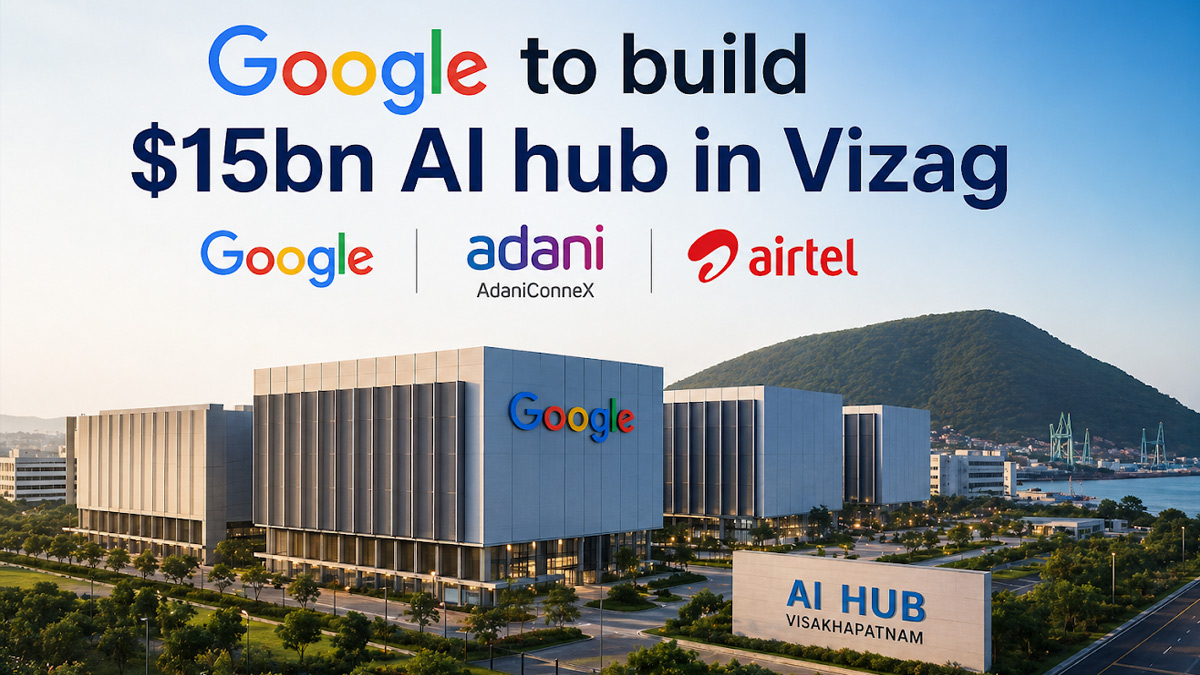
Visakhapatnam: Google has broken ground on what it is billing as India’s largest-ever technology infrastructure project: a gigawatt-scale artificial intelligence hub in Visakhapatnam, Andhra Pradesh, built in partnership with AdaniConneX and Nxtra by Airtel. The ceremony at Tarluvada on 28th April marked the start of construction on a three-campus data centre complex that sits at the heart of a $15 billion investment Google has committed to deploying across India between 2026 and 2030.
The numbers are staggering by any measure. Nearly 1 gigawatt of compute capacity at a single location, three data centre campuses, a fibre-optic expansion under the America-India Connect initiative, and a long-term clean energy strategy designed to feed new renewable supply into the national grid. Google says the project will help India hit its target of 500 gigawatts of non-fossil fuel capacity by 2030 while delivering the high-performance, low-latency infrastructure that businesses need to build and scale AI-powered services.
The groundbreaking drew a formidable gathering of political and corporate India. Union minister for information technology Ashwini Vaishnaw, Andhra Pradesh chief minister N. Chandrababu Naidu and state IT minister Nara Lokesh attended alongside Google Cloud chief executive Thomas Kurian, Adani Group directors Karan Adani and Jeet Adani, and Bharti Enterprises vice chairman Rakesh Mittal.
Vaishnaw framed the project in terms of national ambition. “The India AI hub and three subsea cables landing in Visakhapatnam will become very important infrastructure for the country’s journey forward,” he said, adding his thanks to Google for its “continued trust in India.” Naidu was equally bullish, describing Andhra Pradesh as “India’s premier investment destination” and the Vizag hub as a cornerstone of the state’s technology corridor. “Our vision goes beyond attracting investment,” he said. “We want local talent, startups, and enterprises to become active partners in this technology-driven growth story.”
Kurian called the groundbreaking “a powerful realization of our shared vision with the Indian government, and an inflection point for the country’s AI-native future.” Jeet Adani was characteristically direct: “When energy becomes more affordable and increasingly powered by clean sources, intelligence becomes more accessible, and that is how India will lead the next phase of digital growth.” Gopal Vittal, executive vice chairman of Bharti Airtel, said the full stack of data centres, green power, pan-India fibre and a next-generation cable landing station would enable “large-scale, world-class AI infrastructure in Vizag.”
The project was first announced in October 2025. AdaniConneX and Nxtra by Airtel will lead construction of the data centre buildings and connecting infrastructure, with Google deploying its AI capabilities on top.
Beyond the hardware, Google has announced a substantial package of community programmes. On water, it is partnering with Sponge Collaborative on a watershed management plan linking coastal ecosystem restoration with clean drinking water systems, including reverse osmosis plants and Water ATMs, for local residents. On livelihoods, a tie-up with the Sambhav Foundation will equip more than 1,000 fisherfolk with GPS navigation, weather-forecasting tools, cold-chain management training and UPI-based financial literacy. The Google Udaan India Fund, run through ChangeX, will provide direct grants to local schools and social enterprises for AI skilling labs and digital literacy programmes. The NARI Shakti programme, developed with the Learning Links Foundation, will support more than 10,000 women entrepreneurs from low-income backgrounds in building micro-enterprises. The Skills Trade and Readiness programme will prepare more than 1,000 local workers for construction, welding and facility operations roles, while a parallel tie-up with ICT Academy will train more than 1,200 students and educators in cloud computing and generative AI.
The groundbreaking was accompanied by the Bharat AI Shakti Conclave, a conference organised with the Andhra Pradesh government and Nara Lokesh, bringing together suppliers, industry partners and infrastructure firms to map how Google’s anchor investment can be turned into a broader economic value chain for the region. The conclave’s central theme was building an AI industrial corridor, with a local-first procurement approach and the integration of regional small and medium enterprises into Google’s global operational frameworks.
Every major technology company in the world has been courting India. What sets Vizag apart is the sheer scale of the commitment and the deliberate effort to build an industrial ecosystem around it rather than simply plant servers in a field. Google is not just betting on India’s digital future; it is trying to build the factory floor on which that future gets made. Whether the $15 billion translates into genuine local opportunity, or merely into an impressive data centre humming quietly on the Andhra Pradesh coast, will depend on whether those community programmes prove as durable as the hardware. The groundbreaking, as ever, is the easy part.