I&B Ministry
I&B in talks with ISRO to resolve transponder issue: Bimal Julka

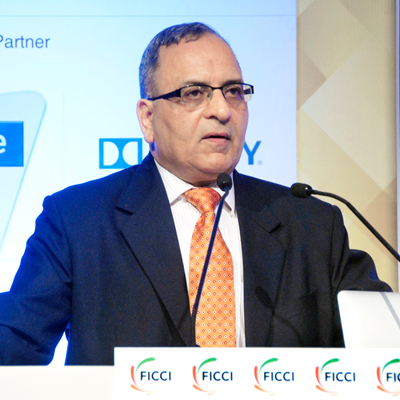
MUMBAI: Day one of FICCI FRAMES 2014, the 15th chapter of the annual convention, witnessed a couple of significant announcements by Information & Broadcasting Secretary Bimal Julka.
“DTH operators have complained that the limited transponder capacity has led them to completely depend on the Ku band. We are engaged in discussions with ISRO (Indian Space Research Organization) and the Department of Space to ensure this problem is resolved at the earliest,” said Julka in an assurance that the I&B Ministry was seriously looking at DTH operators’ demand for more transponders.

With taxes levied on DTH platforms currently including an average of 10 per cent of entertainment tax, licence fees, additional customs duty on set top boxes (STBs), service tax and spectrum charges, Julka touched upon DTH players’ demand for rationalizing taxes so as to help them boost investment in infrastructure development and customers’ activation. “We are in talks with the Ministry of Finance and a consultation on this is on its way. We should be able to resolve the issue soon,” he said.
On the subject of applications for launching new channels pending with the Ministry, Julka said, “An inter-ministerial committee has been set up under the I&B Ministry to look at granting permissions. There are around 800-odd channels currently, while 245 applications are pending for grant of permission. On one side, we get complaints that there are not enough revenues for broadcasters, while on the other side, we are flooded with applications for grant of permission for channels.” He said that in times to come, there would be a large number of mergers and acquisitions among broadcasters. The I&B Ministry is also in talks with the Ministries of Home Affairs, Corporate Affairs and External Affairs to ensure a more smooth process for granting permissions. “At least now, the Ministry of Home Affairs has granted permission and security clearance for channels-to-be for a period of 10 years,” he said.
During his speech, Julka highlighted the strong partnership the Ministry shares with various stakeholders. “We have come out with policies that bring in a paradigm shift in the Media and Entertainment (M&E) industry. We are at the cusp of a major change with digitization, and this will help India put its best foot forward. The change has to be supported by liberal progressive policies that will encourage investment and ensure sustainable business models, promote entrepreneurship and create innovations,” he said. India has 77 million cable TV homes, of which 29 per cent are serviced by DTH operators while Doordarshan’s Free Dish reaches out to nearly 9 million homes. There are roughly 396 non-news channels and 60,000 cable TV operators, 6000 multi system operators (MSOs) and approximately 360 broadcasters; he informed, pointing out that the first two phases of cable TV digitization had been completed in about 42 cities with over 30 million STBs installed. “This was a mammoth task which has been undertaken with the coordination of all stakeholders,” Julka said. “About 110 million STBs are required to be installed in phases III and IV of DAS. Unless these phases are completed, we will not be able to fully harness the fruits of digitization. This is an excellent industry for employment generation.” Lavishing praise on digitization, he said, “It will change the way television is consumed. It will put India in the league of advanced countries.”
On entertainment tax, he informed that preliminary data from state governments reveals a two to three-fold increase in collection of entertainment tax. “The data from news broadcasters shows approximately 30 per cent reduction in carriage fees in phase I cities and data from MSOs shows increase in subscription fees of about 35 per cent to broadcasters,” he said. Stressing on the need to fill in consumer application forms (CAFs), he said, “This is an ongoing exercise. I hope that the MSOs and LCOs are engaged in this exercise and will soon finish it.”
While digitization would bring in transparency which in turn would bring in foreign direct investment (FDI) in broadcasting, Julka didn’t shy away from acknowledging the challenges. “Filling of CAFs, choice of a la carte channels, computerized billing to consumers, and the revenue sharing module between MSOs, LCOs and broadcasters is taking some time, but I am sure it will be resolved soon,” he assured, adding that the government would step in at any time it deems fit. On the ongoing issue of credible ratings, he said, “We are glad that the BARC has been set up. I will request BARC to speed up its process so that we can generate ratings without any delay.”
Julka stressed the importance of digitization. “We need to see complete digitization throughout the country. Also, there are issues of registration of MSOs, monopoly restriction on MSOs and LCOs, and content monitoring. While vertical monopoly and cross media holding is a big issue, it is also engaging the MIB. We will consult the stakeholders before taking a decision on this,” he said on a concluding note.


I&B Ministry
CBFC speeds up film certification; average approval time cut to 22 days
Over 71,900 films cleared in five years as digital system shortens approval timelines
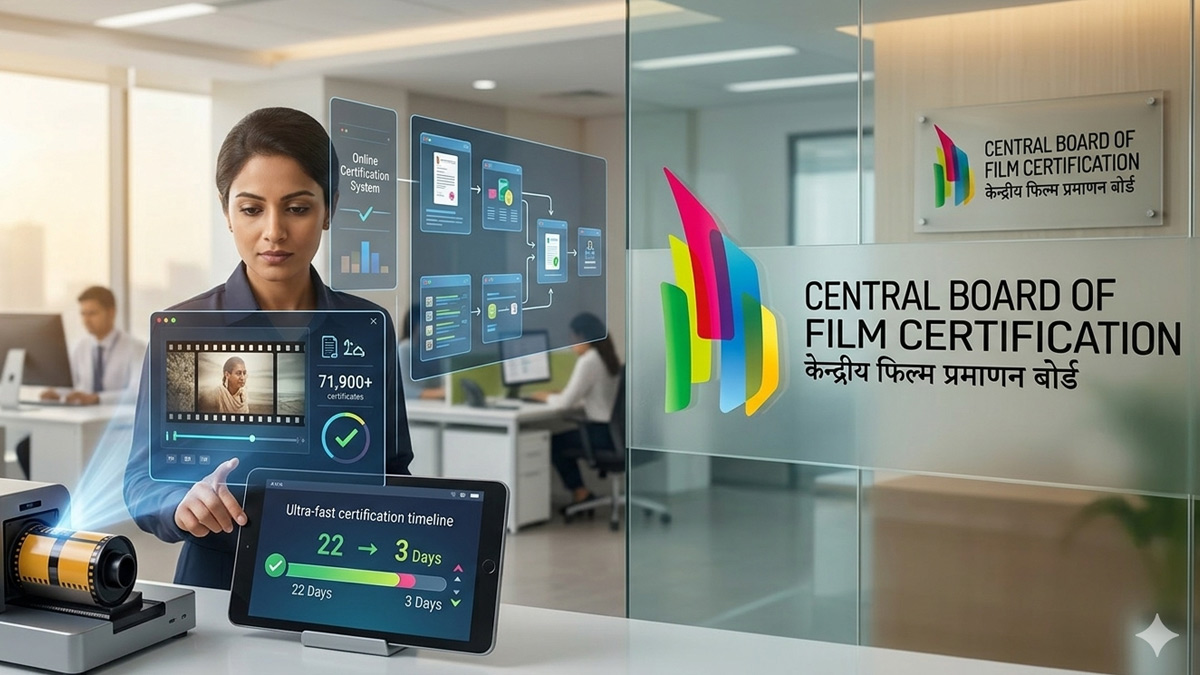
MUMBAI: The Central Board of Film Certification (CBFC) has significantly reduced the time taken to certify films, with the average approval timeline now down to 22 working days for feature films and just three days for short films.
Operating under the Ministry of Information and Broadcasting, the statutory body certifies films for public exhibition in line with the Cinematograph Act, 1952 and the Cinematograph (Certification) Rules, 2024. The rules prescribe a maximum certification period of 48 working days, though the adoption of the Online Certification System has sharply accelerated the process.
Over the past five years, from 2020-21 to 2024-25, the board certified a total of 71,963 films across formats. Of these, the majority fell under the U category with 41,817 titles, followed by UA with 28,268 films and A with 1,878 films. No films were certified under the S category during the period.
Film approvals have also steadily risen in recent years. The CBFC cleared 8,299 films in 2020-21, a figure that peaked at 18,070 in 2022-23 before settling at 15,444 films in 2024-25. During the same period, 11,064 films were certified with cuts or modifications.
Despite the high volume of certifications, outright refusals remain rare. Only three films were denied certification over the last five years, with one refusal recorded in 2022-23 and two in 2024-25.
The board may recommend cuts or modifications if a film violates statutory parameters relating to the sovereignty and integrity of India, security of the state, friendly relations with foreign states, public order, decency or morality, defamation, contempt of court or incitement to an offence.
Filmmakers can challenge CBFC decisions in court. Data shows that such disputes remain limited but have seen some fluctuation. Between 2021 and 2025, a total of 21 certification decisions were challenged before High Courts, with the number rising to 10 cases in 2025.
Responding to a question in the Rajya Sabha, minister of state for information and broadcasting L. Murugan shared the data. The question was raised by Mallikarjun Kharge.
With faster timelines and a largely digital workflow, the certification process appears to be moving at a far brisker pace, signalling a shift towards quicker clearances for India’s growing film output.