iWorld
Facebook to join hands with Indian government

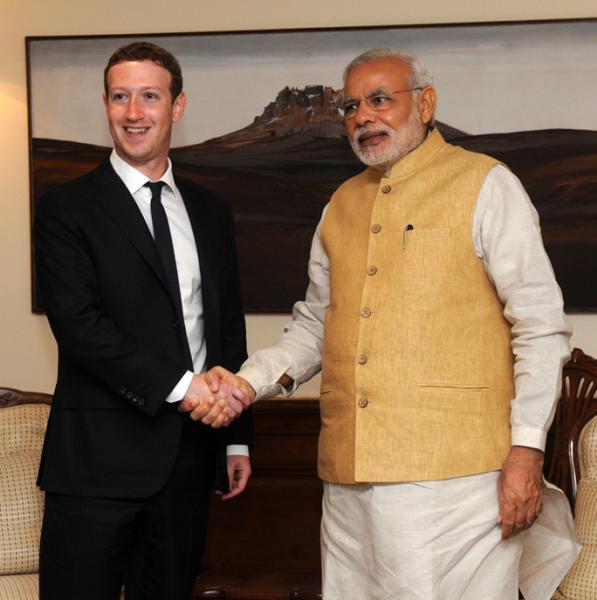
MUMBAI: After swooning the nation with his ideas to enhance the internet connectivity in India in the Internet.org summit, Facebook founder Mark Zuckerberg, who was in the country on a two-day visit, met Prime Minister Narendra Modi on 10 October.
Soon after the meeting, the PM tweeted, “It was wonderful meeting Facebook CEO Mark Zuckerberg. We discussed a wide range of issues.”
The discussion included an array of topics revolving around the innovative use of Facebook as a platform to engage with a large audience in the service of humanity; from helping in the digital India campaign to fighting terrorism using social media.
“I spoke to him about Swachh Bharat Mission. Zuckerberg shared that Facebook would assist the Government of India in the Clean India mobile application. This will surely give an impetus to Swachh Bharat Mission. “
“Zuckerberg is excited about Digital India initiative. I requested him to identify certain areas where Facebook can help us in that. I also requested Zuckerberg to identify how Facebook can help promote India’s rich tourist potential across the world,” Modi posted on his Facebook page.
They also talked about the Digital India initiative. A statement on Modi’s website said, “Zuckerberg said that he is extremely excited about the Digital India initiative of the Government of India. Prime Minister Shri Modi asked him to identify some domains of Digital India where Facebook can get involved and help.”
The Prime Minister appealed to Facebook co-founder to look at how to enhance Internet literacy along with Internet connectivity.
Adding to the same, Zuckerberg stated that Facebook wants to work with the Government of India in the fields of healthcare, education and provide a gamut of services to the people.
He further added that Facebook will also help in the creation of the Clean India Mobile App and that it would be launched soon. This would give a strong impetus to the Swachh Bharat Mission.
In the meeting, PM also pointed out that lots of terrorist elements are using social media platforms to recruit members, according to an official statement.
“This is unfortunate and we need to think of the role the social media can play to stop terror,” Modi said.
Earlier in the day, the Facebook co-founder also met Information Technology Minister Ravi Shankar Prasad as part of the Centre’s ambitious Digital India plan which seeks to expand internet access across the nation.
“Mark’s interest in India impressed me. Facebook wants to work with the Digital India program and the Indian govt is happy to support them in their launch of internet.org,” Prasad said.
“He has shown profound interest to involve Facebook in the Digital India program and in broadband distribution, e-Health, e-Education etc. Really there is a great scope to work together. His idea to promote entrepreneurship among Indians in the field of IT was truly remarkable,” he posted on his Facebook page.
They also spoke about the National Optical Fiber Network (NOFN) project during their meeting which aims to connect 2.5 lakh village panchayats through high-speed broadband by 2017.
Prasad said that he believes there exists a great opportunity for Facebook to harness the vast potential of Indian entrepreneurs in retailing of internet connectivity to the masses by involving local entrepreneurs. Government would extend all cooperation to Facebook in this endeavor.
He proposed that Facebook could contribute to India’s Rs 21,000-crore NOFN project on last-mile connectivity.
Zuckerberg also spoke of alternate technology such as drones and satellite communications playing a critical part in this last-mile linkage.
“India could be the first country in which Facebook deploys drones to provide broadband connectivity in remote and inaccessible areas, with CEO Mark Zuckerberg proposing a pilot project to bridge this digital divide during his meeting,” the IT Minister added.
Facebook’s Connectivity Lab is actively developing large, inexpensive, solar-powered drones that will be able to fly for years at a time, the division’s engineering director Yael Maguire announced earlier this year. These unmanned vehicles will be about the size of a Boeing 747 but weigh only as much as four car tyres while serving as large connectivity hubs.
The drones would fly at a height of 60,000 to 90,000 feet above the ground, far above commercial jetliners and at a level where they wouldn’t be affected by the weather, effectively making them invisible.
In order to continuously provide Wi-Fi coverage, they would be powered by the sun, Maguire had said, adding that these could be tested in the US as early as next year.
On 9 October, while addressing media persons, Zuckerberg had said that Facebook is working extensively in rural India to enhance connectivity. “Internet.org is an effort to bring basic Internet services to all”, he added. The pilot project of Facebook has already helped to connect more than 3 million people with this program. “If we can connect people over here, we can help bring this rich Indian culture to the world.”
Stressing on the importance of connectivity, Zuckerberg had said while India has about 243 million Internet users and have 100 million plus Facebook users, there are over a billion people in the country who do not have access to the net.
The 30-year-old billionaire is the third high-profile head of a US-based tech firm to visit India in the last few weeks, after Satya Nadella of Microsoft and Jeff Bezos of Amazon.