MAM
Reasons Why Term Plan is Important in India

Introduction to Term Insurance
When it comes to securing the future, we are often reminded to plan for unforeseen circumstances. While talking about making investments, things like mutual funds, fixed deposits, and the stock market emerge as top financial options, making us overlook something really important: term insurance. Term insurance is a simple yet powerful tool that holds the key to ensuring your loved ones’ financial security in case something unexpectedly happens to you.
Think of it like this: You are a contributor towards your family expenses. Have you considered whether your family will be able to manage financially in case of your untimely death? This is when term insurance, with its straightforward promise, offers your family adequate financial support upon demise during the term policy period. Even with that fundamental knowledge, a lack of information and not being aware of the benefits of term insurance can influence your decision to buy one. So, make a smart choice and read further to know all about it.

What are the Benefits of a Term Insurance Plan?
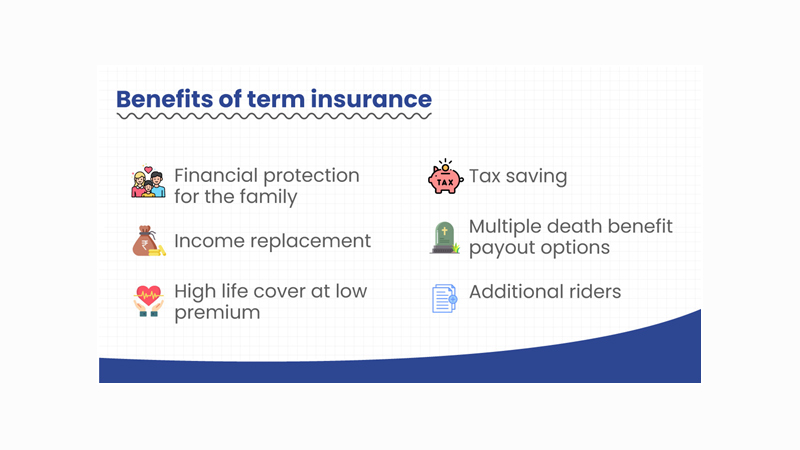
Term insurance, in essence, is everything mentioned above. However, the following benefits will catalyse your decision to secure your family’s future with a robust term insurance plan:
Simple: Term insurance is easy to understand; it is a straightforward life cover without any investment complexities. All you have to do is pay your premiums, and your life is covered for a set period, providing clear benefits for your family.
Affordable: Even though it is remarkably affordable, term insurance offers substantial financial security for your loved ones. For instance, with as little as ₹500 per month, you can provide your family with a ₹1 crore life cover, ensuring they can manage regular expenses, settle debts, and maintain their lifestyle.
Tax benefits: With term insurance, you can also enjoy tax benefits, ensuring not just financial security for your family but also savings for yourself throughout the process.
Peace of mind: Term insurance is the best way to reassure yourself that in your absence, your family will have enough financial support to navigate any challenges that arise, offering you peace of mind and security.
Financial Planning: None of us know what’s in the future. In the event of an untimely demise, relying solely on investments may not prove a wise decision, as they will not suffice to financially protect your family. A term plan, on the other hand, guarantees a substantial payout for considerably affordable annual premiums, ensuring your family’s financial security.
Income Replacement: Term insurance acts as a vital income replacement tool, ensuring financial stability for your loved ones in your absence. It provides a reliable source of income to sustain their needs and lifestyle.
Additional Riders to Strengthen the Policy: Term insurance plans often come with riders that you can choose to boost your basic insurance benefits. You can add them to your term plan by paying a nominal additional premium.
Return of Premium Option: A pure-term insurance plan offers life cover to beneficiaries upon the insured’s death without providing any maturity benefit. However, you can opt for the return of premium option, which entails higher premiums, ensuring a refund of total premiums paid if you outlive the policy tenure.
Please note: Taxes, levies, rider premiums, and modal amounts are excluded from the refunded premium.
We hope this blog helps you understand why term insurance is important and brings an end to your contemplation of the benefits mentioned above. To know more, you can access an easy term guide and make a sound decision about buying term insurance for your family.







MAM
WPP appoints Estée Lauder’s Anne-Isabelle Choueiri as chief transformation officer
Former Estée Lauder executive to lead operations, technology and culture overhaul under WPP’s three-year growth plan

LONDON: WPP has appointed Anne-Isabelle Choueiri as chief transformation officer in a newly created role tasked with delivering the group’s Elevate28 strategy.
Choueiri joins from The Estée Lauder Companies, where she led enterprise-wide strategic initiatives, including the “One ELC” operating model and major upgrades to enterprise marketing, data and analytics capabilities. She also led the redesign of enterprise technology teams and served on the company’s AI taskforce, driving AI strategy, adoption and value realisation across the business.
At WPP, she will be responsible for designing, implementing and embedding the operating model behind Elevate28, the company’s three-year growth plan unveiled in February 2026. She will lead efforts to improve innovation, efficiency and integration across WPP’s client offerings, with a focus on delivering agile, outcome-driven solutions and measurable growth.
Choueiri will oversee organisational transformation across the group, working closely with product and enterprise technology teams to deploy AI, data and technology to build new capabilities and improve operational performance. She will also work with the people function to embed cultural change, strengthen an agile performance mindset and support talent development across the organisation.
Before joining Estée Lauder, she held senior roles across consulting and digital agencies, including at Accenture, Masaï (a Bain & Company spin-off), and Kearney, with experience spanning strategy, data and digital marketing transformation.
Cindy Rose, chief executive officer of WPP, said Choueiri brings a strong track record of leading large-scale transformation across operations, technology and culture, adding that her appointment will help accelerate the group’s next phase of growth under Elevate28.
Choueiri said WPP’s strategy represents an ambitious opportunity to reshape how the company operates and delivers for clients, adding that she looks forward to building integrated solutions and fostering a culture of innovation and change.
She will be based in New York and will join WPP’s executive committee.







