iWorld
Linkedin’s efforts to boost content creation on its platform


Mumbai: Professional online social network LinkedIn is looking to boost content creation efforts in the country. Engagement on the platform, it said, has skyrocketed. The platform said that it has 92 million members in the country. India is one of its fastest growing markets when it comes to member engagement.
LinkedIn APAC head of creator management Pooja Chhabria said that growth in conversations have been responsible for driving more engagement on the platform. The platform has also led to creator conversations. She added, “This is such an important part of the experience of professionals on the platform. We want to continue to invest in that. What we are also keeping in mind is the fact that the core of our content strategy is member value. Members and professionals come to LinkedIn to advance their careers. They want to grow, learn, connect, and have professional conversations. Creators are at the centre of that.”
The aim of LinkedIn, she explains to Indiantelevision.com is to make sure to invest in creators in a way that is core to its mission of having a knowledge marketplace where content creators can impart skills to their community and inform and educate their community. Creators should also share trends and industry insights. This is the work that LinkedIn is doing when it comes to content, which is a part of its growth strategy. She said that LinkedIn’s efforts to boost content creation fall into three buckets.

“Product launches have happened to make it easier for creators to put out content, whether it is video, newsletters, or audio events. The aim is to make sure that creators can put forth stories and experiences in the format that they are most comfortable with. It could be stories or experiences. The second bucket is the content management team at LinkedIn, supporting creators and educating them. Sessions are done to educate creators on the best practices for creating content on the platform. The third bucket is the Creator Accelerator Programme. This was a 10-week programme.”
Bring in diverse voices: The goal of the programme, she explains, was to bring in diverse voices from different professional fields, coach them, educate them, and give them voices and resources. The aim was to help them take their content creation journey on the platform to the next level. Some 200 people took part. “India is the first market after the US where LinkedIn launched this programme. This shows the importance of the country when it comes to our creator’s investment. The creators experienced mentorship and coaching sessions from some of the best content creators in the industry.”
People like Edelweiss Asset Management CEO Radhika Gupta coached the creators. Creators at the programme got to try out various formats, like text newsletters and video events. Chhabria added that thanks to the programme, many creators have become more comfortable with video content creation.
“Two things stand out. One is just the positive feedback that we are getting from the creators. They appreciated the time, effort, and coaching not just from LinkedIn but also from external speakers. The second thing is the tangible impact being seen. The follower growth that they got was two times what it was before they joined the programme. They followed best practices and the tips and tricks that we shared.” Now the company is collecting learnings on how the programme has actually performed. There is interest from more creators. In the US, the second leg has been launched, which focuses on the tech and innovation sector.
New products: On the product side, she said that two new features have been launched. Creators can now have a clickable link on their videos and images so that if they want to lead their community to, for example, a particular learning course or to their site or to a book being launched, that can now be done. So they can actually drive leads based on the objective that they have. The second thing launched is easy-to-use templates. This makes it easier and more engaging for creators to put up posts. This allows creators to quickly adapt and tell their stories. Another product in the works is the carousel format. This will allow creators to put up images and videos in a more engaging manner. “It is in the works, but this is something that I am very excited about.”
Room for various kinds of content: She also mentioned that different types of content gain traction. A creator’s journey is unique. Consumers also prefer to consume content in different ways. LinkedIn’s aim is to provide a varied and diverse set of formats for creators to create content in. There is no one-size-fits-all approach. So a creator can put up a live video event. On the other hand, if someone prefers the written format, then text posts with images, newsletters, or articles can be put up. The aim is to democratise content creation. Just one format will not be pushed. The aim is to make it easier for people to create content in the format that they are most comfortable with.
“In the creator accelerator programme what we saw was that people were very happy to experiment with new formats. In video we saw a 300 per cent growth in adoption. People were inspired because of sessions to try videos. We had sessions for them to explain the process of shooting, editing a video. People already using video took it to the next level. Education, tools and examples of content creation were given. The creators also learnt from each other.”
In terms of content subject matter that gets member traction, she noted that a lot of conversations happen around certain categories like building skills, startups, tech, finance, and entrepreneurship. At the same time, other diverse topics such as responsible A.I., public speaking skills, data science, cybersecurity, environment and sustainability, women’s empowerment, and leadership are gaining prominence. “But the core will always be: what is the member value that is being driven for professionals who log on to our platform? Are they learning a new skill? Are they being informed and educated about something new? Are they getting industry trends and insights? This essentially will be the core of how we invest in content creation.”
Importance of differentiation: The advice LinkedIn gives content creators, she explains, is that content should be differentiated and deep. Creators should also be consistent with an idea. “So if someone talks about public speaking and communication skills, then that person needs to make sure that consistent content is delivered on that subject. That way, their community will recognise that this person is an expert in this area. In this way, creators build their niche communities, who know that they can go to that creator for knowledge, advice, and to get their daily dose of content. Frequency and consistency in putting out content are absolutely important.”
The role of local languages: Hindi content creation was piloted as a part of the content accelerator programme. 35 per cent of creators said that they are interested in creating content in Hindi. There was a 300 percent increase in Hindi content creation during the program. There is an appetite among people to go beyond English and create content in their own language. Video will play a very important role. For LinkedIn to go beyond English, Hindi is a starting point.
In terms of content size being consumed, she said that shorter videos do well. But on the other hand, a one-hour audio event or a 30-minute live event also gets a lot of traction. It depends on the kind of topic that a creator is talking about and the depth that they want to go into. Again, one size does not fit all.
If someone brings in a unique idea and tells it in an engaging way, it always gets engagement. She added that a significant number of the creators who took part in the programme were from tier two and tier three cities. Therefore, the programme was hosted virtually and participation went beyond the Metros.
She added that anybody can be a creator. They have to switch on the creator mode and then the features are available. They can share content, get analytics on their content, see the performance and then improve. “Millions of videos, posts are put up and it skyrocketed, especially during the pandemic. People are sharing much more. There are also more comments. More people have meaningful professional conversations. That is the essence. We have to make sure that LinkedIn is the platform for this and for engaged communities.”
Content relevance: She added that LinkedIn’s teams focus on making sure that the right content reaches the right members based on their interests, skills, and usage of the platform. The company works with creators to ensure that the best quality content is put out there. The product teams work on A.I. and machine learning. “Our vision is to create economic opportunities for every member of the global workforce. When we keep that in mind, we always want to make sure that the right content reaches the right audience.”
She noted that people at the top of their professional fields, like Sugar Cosmetics CEO Vineeta Singh, are very actively creating content on the platform. Singh, for example, discusses entrepreneurship and her experience building a large company. Breakthrough India CEO Sohini Bhattacharya talks about gender equality and how one can stop violence against women. “Our endeavour has always been to bring in these diverse voices who can provide that value to members.”
When asked about the goals of content creation, she said the reasons are varied. It could help people build their personal brand to grow in their career or build their personal brand to build their company brand so that they can look for investments or collaboration opportunities. Another person might look for speaking gigs or to be able to launch a book later. “It is very varied how opportunities show up. Now creators are also getting brand sponsorships as companies see the creators as being able to help them reach out to their targeted communities that align with the brands’ objective.”
“I would say that three things are important for content creators. The first is to define why you are creating content. What is the objective? The second is, what is the niche you are targeting? What is the topic that you will talk about? What is the kind of community that you want to build? The third is that once the community is being built, you have to build a predictable volume of content while keeping quality intact. That is extremely important.”
She also noted that B2B brands already create content on the platform. They have a company page and build their community through content like e-books, reports, and videos to ensure that customers get value through engagement.





iWorld
Micro-dramas rewrite India’s digital storytelling rules
New format delivers 800 hours of content and Rs 650 crore in revenue in 2025 alone.
MUMBAI: Micro-dramas just turned two-minute attention spans into a full-blown industry because when your story has to hook someone before they swipe away, every second counts like a cliffhanger.
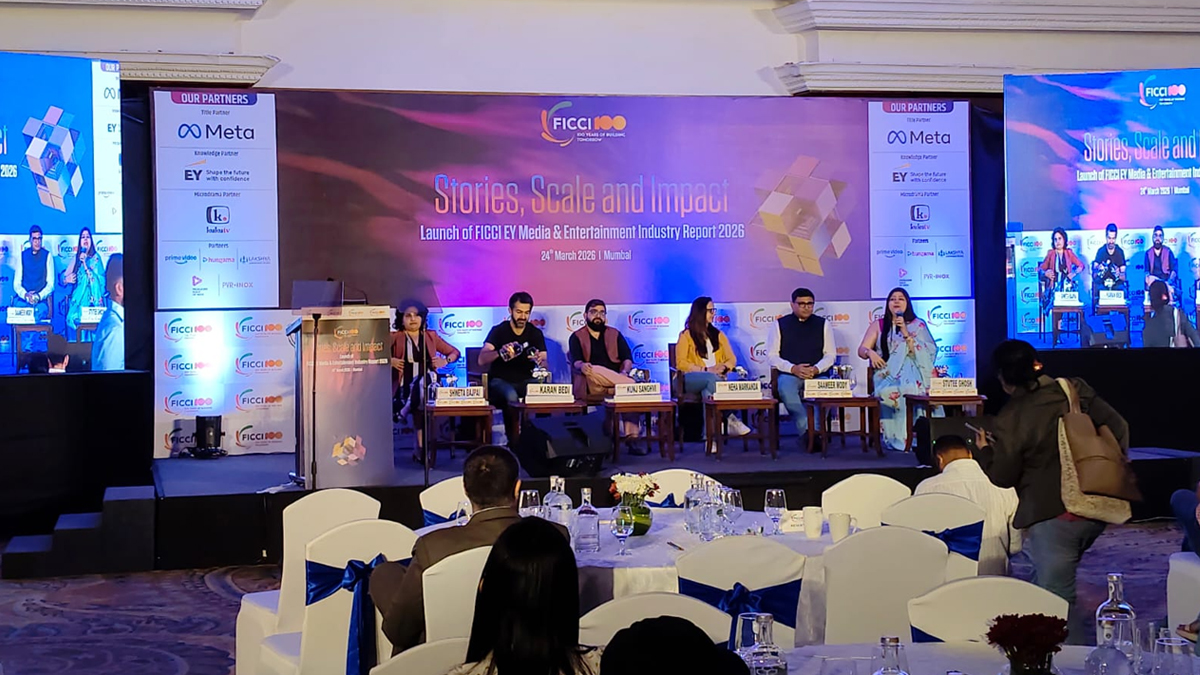
At the FICCI-EY Media & Entertainment Industry Report launch, a high-powered panel explored how micro-dramas are reshaping content creation, discovery and monetisation in India’s digital ecosystem. Moderated by film critic Stutee Ghosh, the session featured Karan Bedi (Director & Head, Amazon MX Player), Kunj Sanghvi (SVP – Content, Kuku TV), Neha Markanda (chief business officer, Sharechat and Moj), Saameer Mody (Founder & MD, Pocket Films & Pocket TV) and Shweta Bajpai (Group Director – Finserv, Media, Travel and Services, Meta India).
The discussion opened with a clear question: what exactly is a micro-drama? Kunj Sanghvi offered the most precise definition, positioning it as content that sits comfortably between long-form films and short-form Reels. “It is feature-length stories 90 to 100 minutes in total told in 45 to 50 episodes of roughly two minutes each,” he explained. The real differentiator, he added, lies in algorithmic distribution on social feeds. A strong cliffhanger at the end of each snippet creates an “uncontrollable urge” to download the app and continue, turning passive scrolling into active consumption.
Shweta Bajpai brought a platform perspective, noting that micro-drama perfectly combines three major trends that have been building for the past four to five years, short-form video, creator-led storytelling, and episodic entertainment. She pointed out that 71 per cent of consumers discovered the category only in the last six months, with a staggering 89 per cent stumbling upon it organically while browsing Reels or Facebook feeds. Once hooked, they click the call-to-action and start bingeing.
One of the most striking revelations was the solitary nature of consumption. According to Meta’s report with Ormax Media, 90 per cent of micro-drama viewing happens alone. This private, personal-screen habit gives creators room to experiment with edgier, more intimate or bold narratives that might not work in a shared family viewing environment.
The panel addressed the frequent criticism that micro-dramas are merely dopamine hits rather than proper storytelling. Saameer Mody countered that telling a compelling story in a very short time is actually harder than in long-form. “Short filmmakers have always said it’s tougher to deliver your message in limited time,” he noted, comparing it to advertising, which has told complete stories in under 30 seconds for decades. “Two minutes is luxury,” he quipped.
Neha Markanda observed that the format’s rapid acceleration has surprised even insiders. From 150 million daily views shortly after launch to 400 million today, with average time spent nearing 50 minutes per day, the growth has been “beyond phenomenal.” She estimated that 10–15 per cent of India’s internet population is already consuming micro-dramas across platforms, leaving massive headroom for expansion. EY predictions suggest the category could grow 3x in three years, but some panellists believe it could be even faster.
Kunj Sanghvi highlighted that genres in micro-dramas evolve and exhaust quickly. “Genres get exhausted really fast,” he said. “After the 50th micro-drama of the same type, the audience already knows what’s coming.” This forces constant innovation and micro-segmentation. Platforms are already serving very specific audiences, IAS aspirants, middle-aged romance seekers, or those who enjoy moral conflicts between doctors and billionaires proving the format’s ability to cater to niche emotional triggers.
Regionalisation is seen as inevitable. While Hindi currently dominates, Tamil and Telugu are growing fast, and vernacular supply is expected to catch up with demand. The cost of creation, already low, is falling further with AI tools, raising the prospect of hundreds of new titles every month in the near future.
Karan Bedi explained MX Player’s decision to keep the format entirely free, “We think there is potentially 800 million screens in India. If we’re at 10–15 per cent penetration today, we have 8x to go.” By removing the paywall, the platform aims to learn rapidly at scale and capture the massive untapped audience.
The panel agreed that micro-drama is not replacing traditional long-form storytelling but adding a new, highly addictive layer tailored to fragmented attention spans and mobile-first habits. As Shweta Bajpai put it, today’s audience is “entertainment hungry, but has less time to spare” and wants content that feels both personal and aspirational.
In a world where everyone is racing against the next swipe, micro-dramas have mastered the art of the perfect hook proving that the smallest screen can still deliver the biggest emotional punch, two minutes at a time. With India still at relatively low penetration compared to China’s 80 per cent, the format is poised for explosive growth, and the only question left is how quickly creators and platforms can keep feeding the insatiable appetite for the next cliffhanger.








