MAM
A quiet ode to Yōko Ogawa’s female gaze
What Haruki Murakami overlooks, Yōko Ogawa insists on seeing


MUMBAI: If there was a Booker Prize for the number of times an author could fail the bechdel test, Haruki Murakami would win it every year, followed closely by John Updike and Philip Roth.
Murakami’s work has long drawn criticism for its depiction of women, who are often rendered less as fully realised individuals than as bodies to be observed. Physicality routinely eclipses agency in his writing, with women framed through a persistent male gaze that mirrors broader societal patterns of objectification.
If Murakami’s fiction is a corridor through which women pass, Yōko Ogawa’s is a room in which they inhabit fully. Here, they can stretch and breathe without every gesture being filtered through a sexualising lens. Here, their sexuality belongs to them alone, free from the weight of judgment.
Why Murakami’s women read like emotional rehab for broken men
In 1Q84 and Norwegian Wood, the female characters are frequently described in ways that emphasise their physical attributes, sometimes in contexts where such details feel gratuitous.
Another common critique centres on how female characters often function within the narrative and lack agency of their own: they tend to appear in the male protagonist’s life as catalysts for his emotional or spiritual development, rather than pursuing their own goals. This “muse” or “medium” archetype, which Murakami himself has acknowledged in interviews, can render female characters as plot devices.
In an interview with novelist Mieko Kawakami, Murakami justified his stance on women when asked about why it can be so exhausting to see this pattern show up in fiction: a reminder of how women are sacrificed for the sake of men’s self-realisation or sexual desire.
He explained, “Not to sound dismissive, but my writing doesn’t follow any kind of clear-cut scheme. Take Norwegian Wood, where Naoko and Midori are respectively grappling with their subconscious and conscious existences. The first-person male narrator is captivated by them both, and it threatens to split his world in two.”
“Then there’s After Dark. The story is propelled almost exclusively by the will of the female characters. So I can’t agree that women are always stuck playing the supporting role of sexual oracles or anything along those lines. Even once I’ve forgotten the storylines, these women stay with me,” he added.
While Murakami may resist schematic intent, the repetition of these tropes across decades of work suggests a structural pattern rather than an incidental one. The prevalence of sexual content involving female characters, has further intensified criticism, particularly in a contemporary literary climate more attuned to questions of power, agency, and representation.
What complicates the debate is Murakami’s global appeal. His work is often praised for its dreamlike atmospheres, emotional loneliness, and metaphysical curiosity, qualities that have earned him a devoted international readership.
For some fans, the women in his novels are symbolic figures operating within a surreal register, not meant to conform to realist expectations. For others, that symbolic framing is precisely the problem: abstraction becomes a convenient alibi for erasure.
Yōko Ogawa and the feminist lens contemporary literature needs
In Yōko Ogawa’s fiction of the late 1980s and 1990s, female narrators often linger over the fragile beauty of youthful masculinity, even as they remain trapped within the abject disorder of feminised domestic spaces. Kitchens, bedrooms and dining tables: sites conventionally associated with care and containment, become zones of unease, where desire, violence and decay coexist.
Food, especially sweet food, recurs as an unsettling motif in Ogawa’s work. Cakes, jam and ice cream appear across Pregnancy Diary (1991), Sugar Time (1991) and Revenge, not as sources of comfort but as expressions of female desire, bitterness and suppressed violence. These images of sweetness often sit alongside moments of bodily harm, hinting at a close link between indulgence and transgression.
In Revenge, they also draw attention to a homosocial female gaze (women observing other women) through which femininity is continually examined, particularly when shaped by anger or harmful impulses. Ogawa’s quiet, self-aware depiction of the woman writer further unsettles these themes, gently destabilising the familiar trope of the “mad” woman whose fantasies are dismissed as excess or pathology.
With prose that is restrained yet deeply unsettling, Ogawa explores memory, the body, desire and isolation, frequently through female perspectives that resist easy categorisation. Below is a curated list of her most widely read and influential works, each offering a distinct entry point into her world of healthy female gaze.
The Memory Police (1994)

Set on a nameless island where objects, and the memories attached to them, disappear without warning, this dystopian novel follows a writer trying to preserve what remains. As language, identity and history erode, Ogawa meditates on power, surveillance and the fragility of human connection. It is her most internationally recognised work.
Revenge: Eleven Dark Tales (1998)
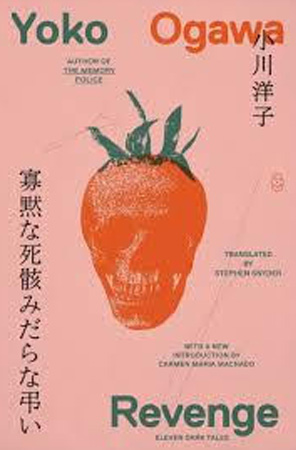
A linked collection of short stories connected by recurring images and characters, Revenge moves through kitchens, hospitals and apartments haunted by death, jealousy and obsession. Violence emerges quietly, often through domestic details, making the book one of Ogawa’s most disturbing and acclaimed works.
The Housekeeper and the Professor (2003)
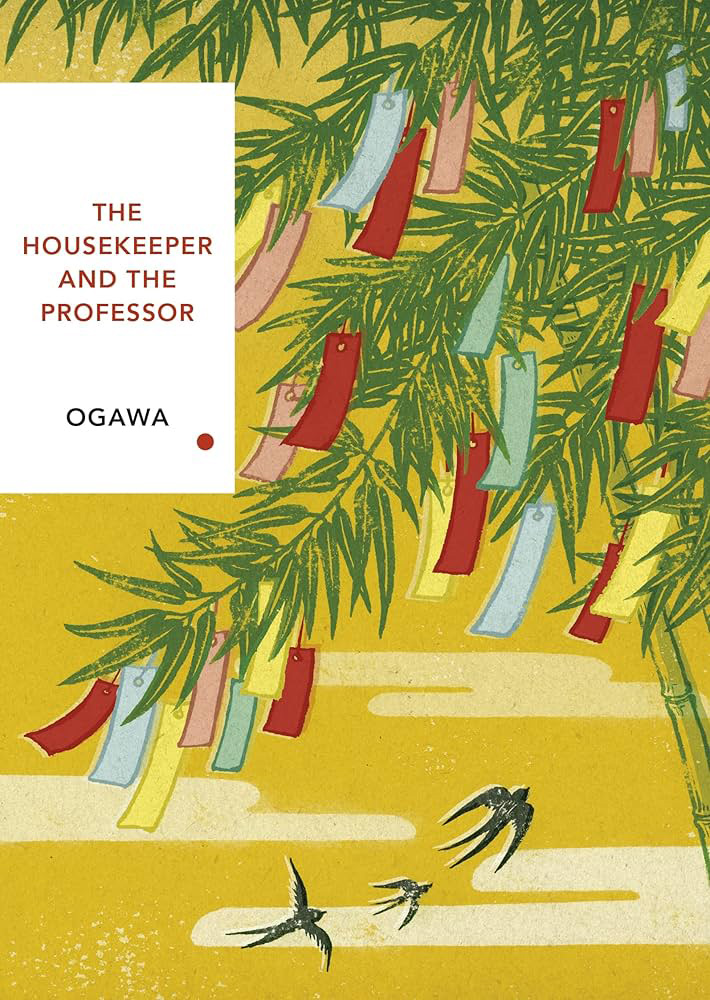
One of Ogawa’s gentler novels, this story centres on a brilliant mathematician who can retain memories for only 80 minutes, and the housekeeper and son who enter his life. Mathematics becomes a language of intimacy, offering moments of grace amid loss and limitation.
Pregnancy Diary (1991)

Told from the perspective of a detached observer, this short novel chronicles a woman’s unsettling fixation on her sister’s pregnancy. Everyday domestic rituals, especially food, become sites of quiet menace, revealing Ogawa’s early mastery of psychological horror.
Hotel Iris (1996)

Set in a decaying seaside town, this novel traces a sadomasochistic relationship between a teenage hotel clerk and an older translator. Spare and disturbing, Hotel Iris examines power, desire and emotional numbness without moral commentary.
The Diving Pool (1990)

This early collection features three novellas exploring adolescent cruelty, voyeurism and repression. In the title story, a young woman’s fascination with a boy at a swimming pool slowly turns sinister, showcasing Ogawa’s ability to mine darkness from stillness.
The Museum of Silence (1995)

A museumologist is invited to work in a remote village where grief and ritual blur into the surreal. This novel reflects Ogawa’s fascination with preservation: of bodies, memories and emotions, and the eerie calm that often accompanies loss.