DTH
GUIDELINES FOR DTH BROADCASTING SERVICE IN INDIA

New Delhi, 16th march, 2001
The union Government has decided to permit Direct-to-Home (DTH) TV service in Ku Band in india. The prohibition on the reception and distribution of television signal in ku Band has been withdrawn by the Government vide notification No. GSR 18 (E) dated 9th January 2001 of the Department of Telecommunications.
The salient features of eligibility criteria, basic conditions /obligations and procedure for obtaining the license to set up and operate DTH service are briefly described below. For further details, reference should be made to the Ministry of information & Broadcasting.
Direct-to-Home(DTH) Broadcasting Service, refers to distribution of multi channel TV programmes in Ku Band by using a satellite system by providing TV signals direct to subscribers premises without passing through an intermediary such as cable operator.
Following are the eligibility criteria for applicants , conditions which will apply to DTH license and procedural details:
I. Eligibility Criteria:
a. Applicant Company to be an Indian Company registered under Indian Company’s Act, 1956.
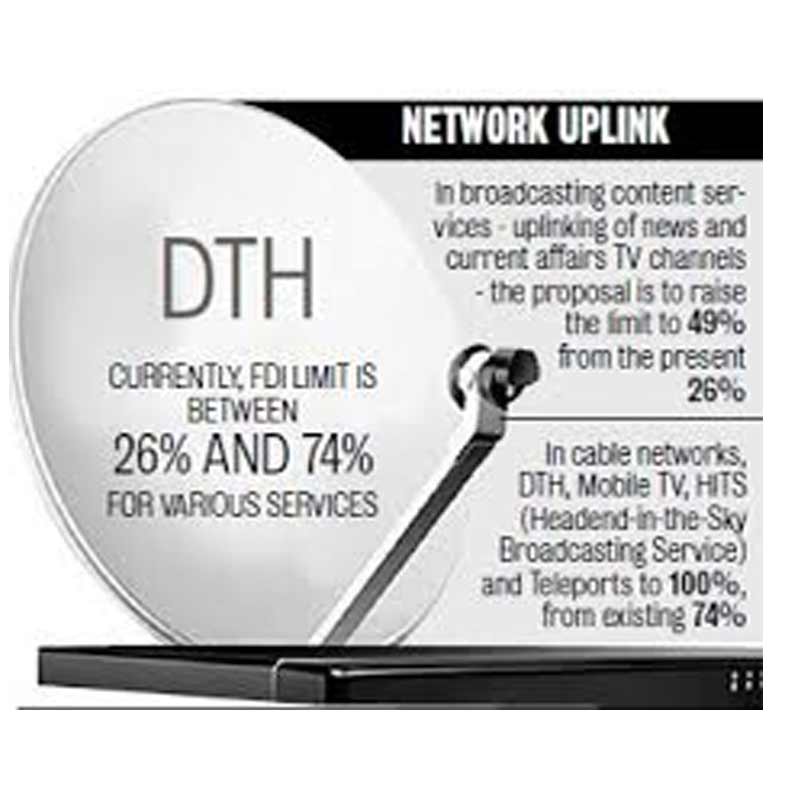
b. Total foreign equity holding including FDI/NRI/OCB/FII in the applicant company not to exceed 49%.
c. Within the foreign equity , the FDI component not to exceed 20%
d. The quantum represented by that proportion of the paid up equity share capital to the total issued equity capital of the Indian promoter Company, held or controlled by the foreign investor through FDI?NRI?OCB investments , shall form part of the above said FDI limit of 20%.
e. The applicant company must have Indian Management Control with majority representatives on the board as well as the Chief Executive of the company being a resident Indian.
f. Broadcasting companies and/or cable network companies shall not be eligible to collectively own more than 20% of the total equity of applicant company at any time during the license period. Similarly , the applicant company not to have more than 20% equity shares in a broadcasting and/or cable network company.
g. The License shall be required to submit the equity distribution of the Company in the prescribed proforma once within one month of start of every financial year.
II. Number of Licensees:
There will be no restrictions on the total number of DTH licenses and these will be issued to any person who fulfills the necessary terms and conditions and subject to the security and technical clearances by the appropriate authorities of the Govt.
III. Period of License:
License will be valid for a period of 10 years from the date of issue of wireless operational license by Wireless planning and Coordination Wing of Ministry of Communications . However , the license can be canceled/suspended by the Licensor at any time in the interest of Union of India.
IV. Basic conditions/obligations:
The license will be subject to terms and conditions contained in the agreement and its schedule
V. Procedure for application and grant of licenses:
a. To apply to the Secretary , Ministry of I&B, in triplicate proforma
b. On the basis of information furnished in the application form, if the applicant is found eligible for setting up of DTH platform in India, the application will be subjected to security clearance in consultations with the Ministry of home Affairs and for clearance of satellite use with the Department of Space.
c. After these clearances are obtained, the applicant would be required to pay an initial nonrefundable entry-fee of Rs.10 crores to the Ministry of Information and Broadcasting.
d. After such payment of entry-fee, the applicant would be informed of intent of ministry of I & B to issue license and requested to approach WPC for SACFA clearance.
e. After obtaining SACFA clearances,within one month of the same ,the License will have to submit a Bank guarantee from any Scheduled Bank to the Ministry of Information and Broadcasting for an amount of Rs.40 crores valid for the duration of the license.
f. After submission of this Bank Guarantee , the applicant would be required to sign a licensing agreement with the Ministry of information and Broadcasting as per prescribed proforma.
g. After signing of such licensing agreement with the ministry of Information and Broadcasting, the applicant will have to apply to the wireless planning & Coordination (WPC) Wing of the Ministry of Communications for seeking Wireless Operational License for establishment , maintenance and operation of DTH platform.
h. The License shall pay an annual fee equivalent to 10% of its gross revenue as reflected in the audited accounts of the company for that particular financial year, within one month of the end of that financial year.
i. The Licensee shall also in addition pay the license fee and royalty for the spectrum used as prescribed by Wireless planning & Coordination Authority (WPC) , under the Department of Telecommunications
VI. Arbitration Clause:
In case of any dispute matter will be referred to the sole Arbitration of the Secretary, Department of legal Affairs, Government of India or his nominee for adjudication. The award of the Arbitrator shall be binding on the parties. The Arbitration proceedings will be governed by the law of Indian arbitration in force at the point of time Venue of Arbitration shall be India.
The detailed procedure proforma and tabled etc. are available on the Internet at the following websites: