MAM
A Final Word on Branding

Pregnant mothers are being pooled to place ads on their round, shiny stomachs as part of “tummy branding.” Some argue that this is how news is created. To some, this is “desperate branding” in action. Welcome to “guaranteed-to-fail branding,” a process that ensures a top spot on the list of branding failures. These projects are sometimes called “reality branding.” There is no limit to these weird processes.
Roy Disney said, “You need branding when your product has nothing to offer.” Roy’s uncle, Walt, invented Mickey Mouse and created the Disney empire. At the time, the word “branding” was reserved only for cowboys branding herds of cattle by the fiery iron.
The word “branding” is dangerously overused. Many people use branding as a cure for all kinds of problems in all kinds of businesses. To lay claim to a deeper understanding of this elementary word, branding agencies all over the world have developed some cute variations of it, from “emotional branding” to “primal”, “sensory”, “musical”, “internal”, “external”, “holistic”, “vertical”, “abstract”, “nervous” and all the way to “invisible” branding. However, to see these distinctions, you will need special 3D spectacles.

The list of branding types is almost like the three MIT wizards who took an academic conference for a ride by submitting a paper all in fake jargon: “Rooter: A Methodology for the Typical Unification of Access Points and Redundancy.” Their paper was accepted.
Haphazard Branding
There are hundreds of such branding terms pointing to the same thing. Let’s analyze and see how this historical process of branding ownership marks on animals got transformed into a word circus, bending the state of mind among corporations, institutions and many governments.
Branding is often presented as a culturally, emotional or lifestyle crazy, sugarcoated packaging process. Sometimes it is like rap music, with spinning colors or psychedelic pastel overtones accompanied with hip-hop idea drivers. Other times it comes with esoteric concepts to camouflage the products or services just long enough to get the customers’ attention. Most of the time, it comes as juicy ideas under some new blanket term of branding that is designed to create a safe and secure feeling for the corporation while waiting for the thunder from the charge of anxious customers.
For some reason, if the highly anticipated traffic doesn’t show up, then the term is changed immediately to the likes of “primal branding,” with a twist or a new style dance added to the circus. The same single promotional process is re-named repeatedly.
The idea is that when share prices fall, call the branding team and let it apply its “fiscal branding” to mail fancy brochures to shareholders. When products fail, let the “visual branding” make logo makeovers, and when elevators don’t work, give it to the “yo-yo branding” unit, as they are real experts in north and south mobility. Floor please.
Today, branding is a mixed bag of basic, traditional advertising tools, simply waxed and packaged to appear as intellectual advice with an expensive price tag. It is targeted to fit any hungry frame of mind, and is designed to make corporations feel ever so comfortable with terms like “verbal”, “digital”, “audio”, “smelly”, “silent” or “loud” branding, as all these terms are designed to offer great safety and invisible lifelines to sinking ships. But does it work?
Just Promotional Tools
At times it does, as corporations do need solid and real branding. However, it most often fails, frequently due to lack of substance, quality, intelligence and experience. What is now being offered in the name of branding includes perfumed stationery at the banks, as sensory tickles, jingles and chimes for the funeral parlor — just raw promotional tricks.
These approaches fail because they are just basic promotional tools and skills and because they are trendy quick fixes. Branding has been defined so many times by so many experts that it is almost useless to redefine it. Like beauty, it is in the eye of the beholder.
The presentation of fancy fireworks at a huge marina as a big branding exercise might be merely ordinary to some other company. Hundreds of hired people walking on a busy street with their foreheads painted with the names of products might be kinky, tacky or too smart, all depending on the culture and mental level of the client.
Pregnant mothers are being pooled to place ads on their round, shiny stomachs as part of “tummy branding.” Some argue that this is how news is created. To some, this is “desperate branding” in action, to others it is getting the word out at any cost.
Welcome to “guaranteed-to-fail branding,” a process that ensures a top spot on the list of branding failures. These projects are sometimes called “reality branding.” There is no limit to these weird processes.
Most of the time, the creative powers overtake the process, and fancy jargon becomes the Band-Aid while the Laws of Global Corporate Image, Rules of Corporate Nomenclature and Name Identities, Cyber Domain Management, Principals of Marketing and Global Branding are all completely ignored as being too rigid, too serious and too formal.
Solid Training, Thorough Skills
Let’s face it, these branding rules are very hard to learn and very difficult to apply because they require solid training and thorough skills. Simple, raw promotional skills backed by big budget fireworks are only “accidental branding” at play, where everyone becomes happy as long as there is some noise. In the recent past, this is how “high volume” or “intense” branding got the center stage. Today, in this budgetless environment, it is only a dream for most agencies to get such mega breaks.
US businesses are still very much overdosed with over-branding. Massive turnover in the advertising and branding industry, compounded by the Internet, e-commerce and outsourcing has created a large glut of branding consultants with too many faceless, nameless consulting services and Web sites.
The market is simply glutted. Western branding agencies are losing their grip by not producing world-class standards and are becoming a laughing stock by adopting, in a panic, monkey-see-monkey-do campaigns.
In reality, you definitely need proper branding today; the type is not the issue. However, first you must have something very good to offer. You also need highly specific and proven branding with highly tactical positioning skills, under proper corporate and brand name identity and image laws, rather than raw graphic and promotional tools.
‘Useless Branding?’
Empty concepts and poorly designed and beaten up products and services can’t be resurrected with some abstract branding terms along with some flashy campaigns. Big money spending will not buy big image anymore. It worked in the past, but times have changed. Today, the latest cyber-branding techniques are in big play. Corporations are opening up to a debate on this subject among senior management and ignoring the old, traditional branding methodologies.
As e-commerce matures by the minute, the masses of customers have successfully ignored the expensive blitzes and pretended to have some type of an early Alzheimer’s condition to justify their memory loss. Nothing sticks in mind any longer.
The blasted, useless messages are instantly forgotten. The 15-minute fame suggested by Andy Warhol is now only a 15-second blip on the global e-commerce landscape. What was previously shoved on 24/7 ad campaigns and lasted at least a year is now completely forgotten the very next day.
Should we now re-define branding all over again? Should this word be re-invented? How about “useless branding?” No, not yet.






MAM
Dinshaw’s launches 3x chocolate cone with ‘Dildaari’ campaign
Vinod Kambli fronts summer push built around richer final bite.
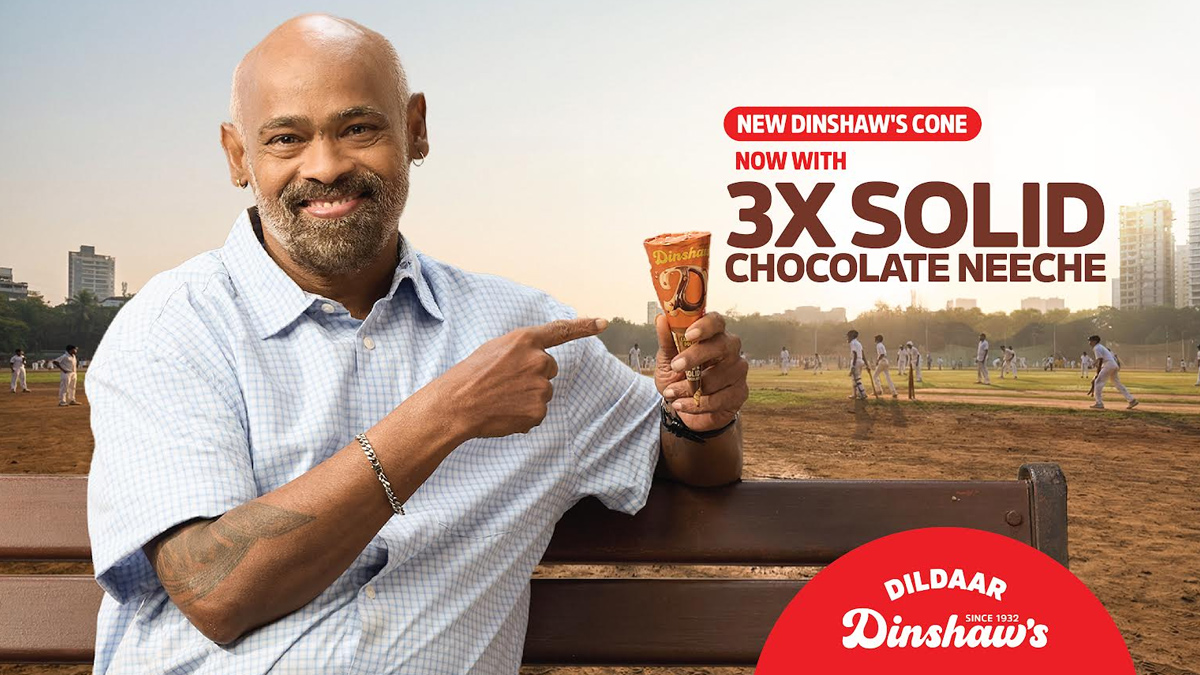
MUMBAI: The sweetest part of an ice cream may no longer be the first lick, it is now the last word. Dinshaw’s is rewriting the rules of cone indulgence with its new ‘Dildaari’ campaign, built around a simple twist: three times more solid chocolate at the tip.
At the centre of the launch is a familiar consumer truth, the final bite of a cone is often the most anticipated. Dinshaw’s is leaning into that moment, turning it into the hero by amplifying the chocolate layer at the bottom, effectively repositioning the end of the cone as the highlight of the experience.
The campaign is fronted by former Indian cricketer Vinod Kambli, whose personal journey lends an emotional undertone to the storytelling. Built around the line “Jinko life mein thoda kam mila, unke liye thoda zyada”, the narrative blends nostalgia with generosity, framing the product upgrade as more than just a feature, it is a gesture.
Timed for peak summer and the ongoing cricket season, the campaign taps into moments of heightened consumption and sentiment, where small indulgences carry outsized emotional value.
The new range features nine flavours Badam Roasted, Butterscotch, Caramel Dolce, Choco Chip, Chocolate Brownie, Chocolate Ganache, Cookies n Cream, Mississippi Dark and Mocha Black and White each designed to complement the enhanced chocolate finish.
Conceptualised by Womb, the campaign pivots away from functional messaging to a more human insight: that sometimes, the smallest additions can make the biggest difference.
As brands continue to hunt for differentiation in a crowded category, Dinshaw’s bet is clear, if you cannot change the whole cone, make the last bite unforgettable.