Hindi
‘Tasher Desh’ based on Tagore play set for release on 23 August

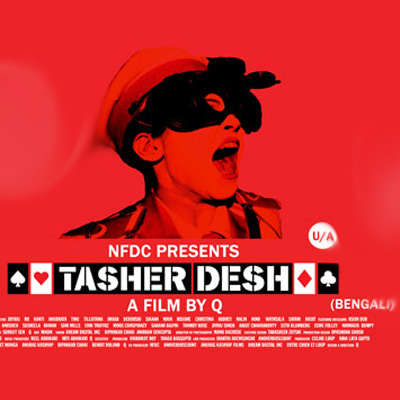
NEW DELHI: The film Tasher Desh (The Land of Cards), a fantasy film in Bengali made on a play by Nobel laureate Rabindranath Tagore directed by Q (Qaushiq Mukherjee), will be released in theatres on 23 August with English sub-titles.
The film which has already been screened in Rome, London, Amsterdam and Toronto Film Festivals, has been produced by the National Film Development Corporation, Overdose Joint, AKFPL (Anurag Kashyap Films Pvt Ltd), Entre Chien Et Loup, and Dream Digital Inc.

The film stars Rii (Rituparna Sen), Tillotama Shome, Joyraj Bhattacharjee, Soumyak Kanti De Biswas, Anubrata Das, Arijit Dutta, Imaad Shah, Tinu Verghis, and Maya Tideman.
Though the original play and music is by Tagore, the music in the film is by Neel Adhikari/Miti Adhikari/Q. The musicians featuring in the film are Asian dub foundation Susheela Raman Sam Mills Eric Truffaz Moog Conspiracy Anusheh Sahana Bajpai Jens chr. Bugge Wesseltoft Tanmoy Bose Jivraj Singh Diego Neel Adhikari Miti Adhikari Arijit Chakraborty Seth Blumberg Esme Folley Nirmalya de Biswas Mainak nag Choudhury.
The film is in the form of a story-teller wanting to tell a story. The story he tells mingles between his own story and that of a queen and her son banished to a palace where they lead a life of luxury and decadence. An oracle whispers the secret words to the prince and he leaves the palace with his friend, the merchant’s son. Their boat sinks and they arrive at the land of cards where the inhabitant cards are governed by a military regime. The prince and his friend get caught and bring about a change in the women cards with music and prophecies of love. The woman cards revolt. The king who banished them surrenders and the prince finds the meaning of life.



Hindi
Jio Studios, Sanjay Dutt team up to revive Khal Nayak
Rights acquired for new version, format under wraps as remake plans take shape.

MUMBAI: The villain is back and this time, he’s rewriting his own script. Jio Studios has partnered with Three Dimension Motion Pictures and Aspect Entertainment to revive the 1993 cult classic Khal Nayak, marking a fresh chapter for one of Bollywood’s most iconic anti-hero stories. The original film, directed by Subhash Ghai under Mukta Arts, was a commercial and cultural milestone, with Sanjay Dutt’s portrayal of Ballu becoming one of Hindi cinema’s most memorable performances.
Dutt, along with Aksha Kamboj, has now acquired the rights from the original creators, bringing on board Jio Studios and its President Jyoti Deshpande to steer the project creatively.
While the exact format whether remake, sequel, prequel, or a completely new narrative remains undisclosed, the collaboration aims to reinterpret the story for contemporary audiences while retaining the essence that made the original a defining film of the 1990s.
The move taps into a broader industry trend of reviving legacy intellectual property, particularly characters with strong recall value. “Khal Nayak” was notable for pushing mainstream Hindi cinema into morally grey territory at a time when heroes were largely one-dimensional, making Ballu’s character a standout.
The project also marks the film production debut of Aspect Entertainment, signalling a push towards more technology-led storytelling frameworks. Meanwhile, Jio Studios continues to expand its slate, having built a library of over 200 films and series, with more than 60 titles collectively winning 500-plus awards.
For Dutt, the revival is as much personal as it is strategic, a return to a role that reshaped his career. For the industry, it is another sign that nostalgia, when paired with scale, remains a powerful box-office proposition.
Because in Bollywood, some villains never fade, they just wait for the perfect comeback.