DTH
Tata Play & Airtel Digital TV to Merge in Share Swap Deal – Economic Times report

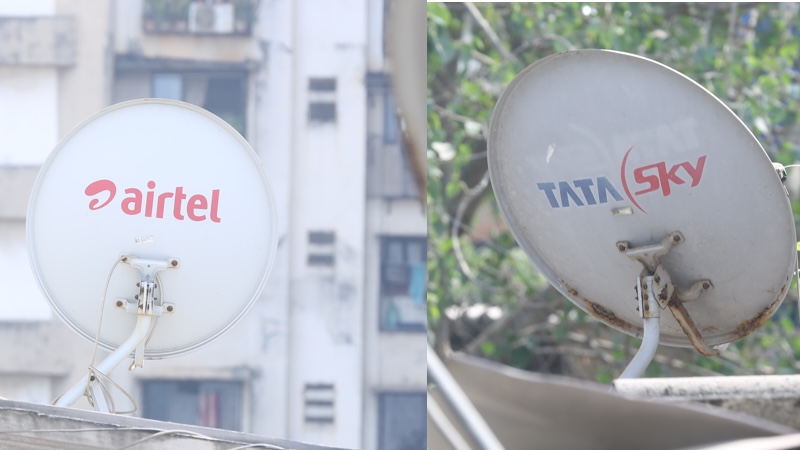
MUMBAI — A major consolidation is underway in India’s television distribution landscape as Tata Play and Airtel Digital TV prepare to merge through a share swap, according to a report by The Economic Times.
The deal will see Airtel holding over 50 per cent of the combined entity, effectively consolidating India’s direct-to-home (DTH) sector as viewers increasingly shift towards digital streaming platforms.
Tata Play, formerly known as Tata Sky, is India’s largest DTH provider and was previously a joint venture with Rupert Murdoch’s News Corp, which was later acquired by Disney in 2019. Through this merger, Airtel will gain access to Tata Play’s 19 million subscribers, bolstering its strategy to bundle telecom, broadband, and DTH services.

The merger follows the 2016 consolidation of Dish TV and Videocon d2h, and comes amid Reliance Industries and Disney combining Star India and Viacom18 to form JioStar, now India’s largest media company with Rs 26,000 crore revenue in FY24.
First reported by The Economic Times on 8 October 2024, the agreement is expected to be formalised soon. Airtel is likely to control 52-55 per cent of the new entity, while Tata Play’s shareholders, including Disney, will retain 45-48 per cent. Tata Sons is reportedly seeking two board seats, while Airtel’s management is expected to lead operations.
“This will be a non-binding agreement,” an executive familiar with the deal told the newspaper. “Both parties have been engaged for months and are expected to resolve outstanding issues quickly.”
Both companies are valued at between Rs 6,000-7,000 crore each. Airtel Digital TV operates under Bharti Telemedia Ltd, a wholly owned subsidiary of Bharti Airtel. Tata Sons owns 70 per cent of Tata Play after acquiring Temasek Holding’s 10 per cent stake in April 2024 for Rs 835 crore, valuing Tata Play at $1 billion, down from its pre-pandemic $3 billion.
Disney is expected to maintain its stake in the merged entity. As of September 2024, the two DTH providers had a combined 35 million subscribers, generating over Rs 7,000 crore in revenue in FY24. Tata Play also serves 500,000 broadband customers.





DTH
Dish TV moves court seeking level playing field with DD Free Dish
DTH player flags unfair edge as free platform reshapes pay-TV market
MUMBAI: Dish TV has approached the Kerala High Court, seeking a level playing field with DD Free Dish, the free-to-air satellite platform run by Prasar Bharati.
At the heart of the dispute is what Dish TV calls a regulatory imbalance. The company has urged the Ministry of Information and Broadcasting to bring DD Free Dish under the same rules as private direct-to-home operators, including mandatory encryption and compliance with the Digital Addressable System under existing laws such as the Indian Telegraph Act and the Cable Television Networks (Regulation) Act.
Private DTH platforms are required to encrypt their signals, meaning viewers need authorised set-top boxes and paid subscriptions. In contrast, DD Free Dish remains unencrypted, allowing access through basic equipment without monthly fees, a difference Dish TV argues creates a structural advantage.
In its petition, Dish TV has described the current framework as arbitrary and discriminatory, alleging it undermines constitutional guarantees of equality and the right to trade. The company pointed out that while private operators shoulder the cost of encryption infrastructure, licensing fees and regulatory levies, DD Free Dish operates without similar obligations despite scaling up significantly.
Originally launched to distribute Doordarshan channels, DD Free Dish has steadily morphed into a quasi-commercial platform. It now carries around 120 private channels and generates substantial revenue through slot auctions, with earnings rising sharply over the years, according to the petition.
The case also throws a spotlight on shifting dynamics within India’s television market. Pay DTH operators have been grappling with a shrinking subscriber base, which has fallen from nearly 70 million in 2021 to about 51 million in 2025. At the same time, DD Free Dish has expanded its reach to roughly 53 million households, buoyed by viewers in price-sensitive regions opting for free access over paid subscriptions.
The migration has been further fuelled by broadcasters placing popular channels on the free platform, making it an increasingly attractive alternative for households looking to cut costs.
The Kerala High Court has admitted the petition and scheduled the next hearing for June 2, 2026. It also noted that a recent notice by Prasar Bharati inviting regional channels to uplink on DD Free Dish without carriage fees until March 31, 2026 will remain subject to the final outcome of the case.
Regulators have already acknowledged the gap. The Telecom Regulatory Authority of India, in its July 2024 recommendations, proposed a shift towards an addressable system for DD Free Dish, though these suggestions are not binding. The government is yet to take a final call, mindful of the platform’s reach among millions of households.
The petition follows repeated representations from private players and bodies such as the All India Digital Cable Federation, all flagging the same concern: a fast-growing free platform competing in a paid market without the same rulebook.
As the courtroom battle unfolds, the outcome could redraw the contours of India’s pay-TV ecosystem, deciding whether the free ride continues or the rules of the game finally converge.






