English Entertainment
Comedy Central enters April with interesting line-up

MUMBAI: Comedy Central is all set to roll into the month of April with a new line-up that will entertain you more than the April Fool’s Day jokes! With premieres of shows and seasons, this month will also see a quirky celebration of April Fool’s Day.
In addition to its existing line-up of hilarious day and date shows like Man With A Planand The Great Indoors, the channel will now premiere new seasons of shows such asThe Graham Norton Show.
The channel will also introduce new shows such as Suburgatory season 1-3, Sirensseason 1-2, Whitney season1-2, Wrecked season 1 and Impastor season 2 in its programming roster for this month.
Viacom 18 head of programming English Entertainment Hashim D’Souza said, “We are already three months into the year and it has, so far, been an amazing one! New shows, new seasons, there’s so much happening on the channel. This month is going to be even better because it’s packed with Indian TV premieres. We are extremely thrilled about it and hope that the viewers like it just as much we loved planning it.”
The all new line-up includes:
Show: April Fool’s Day special
Date: Saturday and Sunday, 1-2 April| Time: 12 pm
Synopsis:
On a day which is all about jokes, hoaxes, tricks and pranks, Comedy Central is the best in the business! We’ve got your entire weekend covered with Penn Jillette, Raymond Joseph, Ashton Kutcher and Amir Blumenfeld, leading from the front to show you how it’s done!
The channel will air Penn & Teller: Fool Us!, Pranked and Punk’d for six hours each on1st & 2nd April (Saturday & Sunday) from 12 Noon onwards.
Further, the channel is also celebrating the day on social media, asking people to laugh off their tax worries and celebrate the day instead! This day is not just about pranking someone, it’s the funniest day of the year and Comedy Central wants to help its viewers to get out of the stress zone and laugh with them!
Show: Impastor s2
Date: Monday, 3 April| Time: 10 pm
Synopsis:
The second season starts off with Buddy being cuffed and locked in a car by Lovello and Hyde only to be pursued by Damien. Lovello and Hyde narrowly escape leaving Buddy to convince the detectives that he is an undercover FBI agent who witnessed the suicides of Jonathan Barlow and his true self. The detectives place a tracking anklet on Buddy and give him 24 hours to find Damien.
Show: The Graham Norton Show s21
Date: Saturday, 15 April | Time: 10 pm
Synopsis:
BAFTA Award-winning comedian Graham Norton hosts this long-running, eponymous talk show in which he discusses the people, trends and news stories that interest him the most. He performs a monologue and other comedy sketches, which include eccentric stories and characters while welcoming celebrity guests and musical performers. The hour-long program often includes madcap audience participation and the red chair.

Show: Suburgatory season 1-3
Date: Monday, 10 April | Time: 10:30 pm
Synopsis:
The series follows a single father who decides to relocate from New York City to the suburbs, so he can give his teenage daughter a better life. However, their move has them wondering if they just entered the world of the Stepford Wives.
Show: Sirens season 1-2
Date: Thursday, 13 April | Time: 9:30 pm
Synopsis:
A comedy that follows three Chicago Emergency Medical Technicians (EMTs) who despite their narcissistic and self-destructive personalities are uniquely qualified to save lives.
Show: Wrecked season 1
Date: Monday, 17 April | Time: 10 pm
Synopsis:
A parody of “Lost”, the show follows the strange antics of a diverse group of survivors after a plane crashes on a remote island.
Show: Whitney season 1-2
Date: Tuesday, 18 April| Time: 9 pm
Synopsis:
The series follows Whitney, her very supportive live-in boyfriend Alex and their friends who are all twenty-somethings living in Chicago.


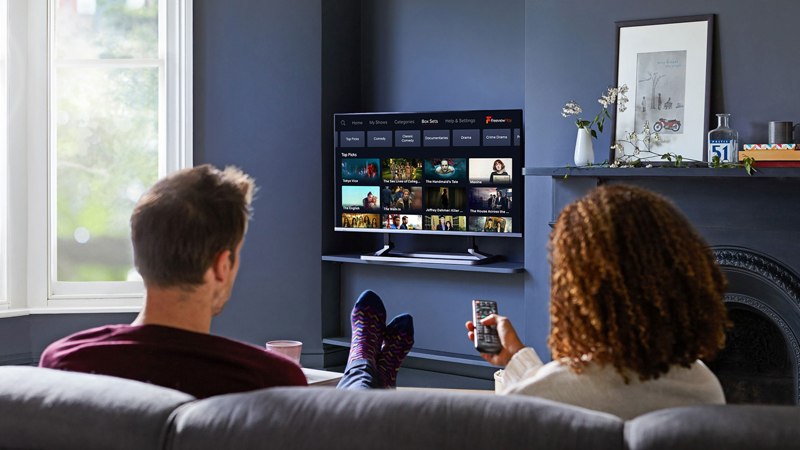
UK: The aerial is losing its grip. As broadband becomes the default way Britons watch television, the UK is edging towards a decisive, and divisive, question: should Freeview be switched off by 2034? The issue, highlighted in reporting by The Guardian, has exposed deep fault lines over access, affordability and the future of public service broadcasting.
For nearly 25 years, Freeview has delivered free-to-air television from the BBC, ITV, Channel 4 and Channel 5 to almost every corner of the country. Even now, it remains the UK’s largest TV platform, used in more than 16m homes and on around 10m main household sets. Yet the same broadcasters that built it are now pressing for its closure within eight years.
Their case rests on a structural shift in viewing. Smart TVs, superfast broadband and the Netflix-led streaming boom have pulled audiences online. Advertising economics have followed. By 2034, the number of homes using Freeview as their main TV set is forecast to fall from a peak of almost 12m in 2012 to fewer than 2m, making digital terrestrial television, or DTT, increasingly costly to sustain.
But critics say the rush to switch off risks abandoning those least able, or least willing, to move online.
“I don’t want to be choosing apps and making new accounts,” says Lynette, 80, from Kent. “It is time-consuming and irritating trying to work out where I want to be, to remember the sequence of clicks, with hieroglyphics instead of words. If I make a mistake I have to start again.”
Lynette is among nearly 100,000 people who have signed a “save Freeview” petition launched by campaign group Silver Voices. She fears the government is about to “take [Freeview] away from me and others who either don’t like, can’t afford, or can’t use online versions”.
Official figures underline the fault lines. A report commissioned by the Department for Culture, Media and Sport estimates that by 2035, 1.8m homes will still depend on Freeview. Ofcom’s analysis shows those households are more likely to be disabled, older, living alone, female, and based in the north of England, Wales, Scotland and Northern Ireland.
Freeview is owned by the public service broadcasters through Everyone TV, which also operates Freesat and the newer streaming platform Freely. After two years of review, DCMS is expected to set out its position soon, drawing on three options proposed by Ofcom: a costly upgrade of Freeview’s ageing technology; maintaining a bare-bones service with only core PSB channels; or a full switch-off during the 2030s.
The broadcasters have rallied behind the third option. They argue that 2034 is the logical cut-off, when transmission contracts with network operator Arqiva expire. By then, they say, the cost of broadcasting to a dwindling audience will far outweigh the returns from TV advertising.
Ofcom agrees a crunch point is approaching. In July, the regulator warned of a “tipping point” within the next few years, after which it will no longer be commercially viable for broadcasters to carry the costs of DTT.
Others see risks beyond economics. Questions remain over whether internet TV can reliably deliver emergency broadcasts, such as the daily Covid updates, in the way that universally available DTT can. The UK radio industry has also warned that an internet-only future for TV could push up distribution costs and force some radio stations off air if PSBs no longer share Arqiva’s mast network.
“It is a political hot potato,” says Dennis Reed, founder of Silver Voices, who says he has “dissociated” his organisation from the government’s stakeholder forum, which he believes is “heavily biased” towards streaming.
The Future TV Taskforce, representing the PSBs, counters that moving online could “close the digital divide once and for all”. “We want to be able to plan to ensure that no one is left behind,” a spokesperson says, adding that rising DTT costs could otherwise mean cuts to programme budgets.
The numbers show the scale of the challenge. Of the 1.8m Freeview-dependent homes projected for 2035, around 1.1m are expected to have broadband but not use it for TV. The remaining 700,000 are forecast to lack a broadband connection altogether.
Veterans of the analogue switch-off, completed in 2012 after 76 years, recall similar fears of “TV blackout chaos”. Around 6 per cent of households were labelled “digital refuseniks”, yet a targeted help scheme and a national campaign, fronted by a robot called Digit Al voiced by Matt Lucas, delivered a largely smooth transition.
This time, the BBC is less keen to foot the bill. Tim Davie, the outgoing director general, has said the corporation should not fund a comparable support programme for a Freeview switch-off.
Research for Sky by Oliver & Ohlbaum suggests that with early awareness campaigns and digital inclusion measures, only about 330,000 households would ultimately need hands-on help ahead of a 2034 shutdown.
Meanwhile, viewing habits continue to fragment. Audience body Barb says 7 per cent of UK households no longer own a TV set, choosing to watch on other devices. In December, YouTube overtook the BBC’s combined channels in total UK viewing across TVs, smartphones and tablets, albeit measured at a minimum of three minutes.
That shift may accelerate. YouTube has recently blocked Barb and its partner Kantar from accessing viewing session data, limiting transparency just as online platforms consolidate power.
“When the government chose British Satellite Broadcasting as the ‘winner’ in satellite TV it was Rupert Murdoch’s Sky instead that came out on top,” says a senior TV executive quoted by The Guardian. “There already is such an outsider ready to be the winner in the transition to internet TV; it is YouTube.”
Freeview’s future now hangs on a familiar British dilemma: modernise fast and risk exclusion, or protect universality and pay the price. Either way, the aerial’s days as king of the living room look numbered.